KONTAKTE
Festival for Electroacoustic Music and Sound Art
The KONTAKTE Festival highlights the diverse responses of contemporary sound art to current technological and social developments. Every two years, the Akademie venues on Hanseatenweg and Pariser Platz are filled with experimental sound structures, transforming them into spaces for intense listening.
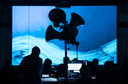
Still from Julia Mihálys Main Under – Reloaded
© MUTESOUVENIR
About the Festival
The name “Kontakte” refers to Stockhausen's groundbreaking work of the same title (which created a new context for connecting musical categories) as well as to the series of events initiated in the 1980s by Georg Katzer at the Studio for Electroacoustic Music of the Akademie der Künste.
The festival builds on this tradition and presents current positions in electroacoustic music and sound art. KONTAKTE sees itself as a platform for innovation, interdisciplinary exchange and intensive listening. International artists and partner institutions contribute to keeping the tradition of electroacoustic music alive and providing new impulses.
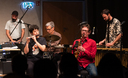
Tony Elieh, Passé Composé, KONTAKTE 2025
© MUTESOUVENIR
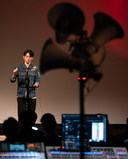
Seung-Jin Hong, KONTAKTE 2025
© MUTESOUVENIR
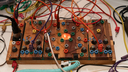
Hainbach, KONTAKTE 2025
© MUTESOUVENIR
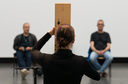
Susanne Fröhlich and Gerriet Krishna Sharma, Huge Crash – So Far – Not Guilty, KONTAKTE 2025
© MUTESOUVENIR
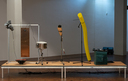
Berliner Lautprecherorchester, KONTAKTE 2025
© MUTESOUVENIR
Review 2025
From 26 to 30 June 2025, sound installations, striking performances and electroacoustic concerts came together to form a multi-layered and interdisciplinary programme featuring, amongst others, the Ensemble Ascolta, the GrauSchumacher Piano Duo, Thomas Schulz and Hanna Hartman, as well as new works by Arezou Rezaei, Tony Elieh, Hainbach, Annette Krebs, Heather Frasch, Gerriet K. Sharma, Susanne Fröhlich – and what is probably the world’s most extensive loudspeaker orchestra to date.
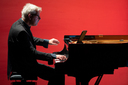
GrauSchumacher Piano Duo, KONTAKTE 2025
© MUTESOUVENIR
GrauSchumacher Piano Duo, Ming Tsao
The GrauSchumacher Piano Duo specialises in a repertoire for two pianos, with a focus on contemporary music. In collaboration with internationally renowned composers, they regularly present world premieres, new concert formats and transdisciplinary projects.
The composer Ming Tsao creates a distinctive, ethereal style of music by focusing on the “materiality” of sound. With a precise, formally rigorous style, he crafts a contemporary, lyrical musical language full of breaks and shifting perspectives.
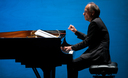
GrauSchumacher Piano Duo, KONTAKTE 2025
© MUTESOUVENIR
Ming Tsao’s Plus or Minus is based on Karlheinz Stockhausen’s experimental composition Plus-Minus (1963–1973) and interprets its seven pages as a two-layered structure for two pianos. One layer strictly follows the instructions of the score, whilst the other uses fragments from Stockhausen’s Mantra (1970) as contrasting material. The work explores the tension between rule and deviation, structure and sound – asking what freedom of choice means in composition.
Downloads
Review 2024
NODES is the little sister of KONTAKTE and took place as a shorter, one-off festival in 2024. From 1 to 3 June, a dense programme of electroacoustic music, performances and sound art was presented on Hanseatenweg. The focus was on the diversity of the Berlin scene.
The Berliner Lautsprecherorchester, comprising students from the Berlin University of the Arts (UdK) and the Hanns Eisler School of Music Berlin (HfM), performed pieces using up to 24 loudspeakers. To mark Folkmar Hein’s 80th birthday, the German Society for Electroacoustic Music (DEGEM) presented a selection of works commissioned by the former director of the legendary studio at the Technical University of Berlin. In addition, works by fellows Viola Yip and Katharina Zimmerhackl, as well as by Manfred Miersch, were performed. Twenty years after the initial concept was conceived, Stefan Streich presented his concert-style multimedia installation Vier Celli for the first time. The event concluded with a live programme by Radio Industry.
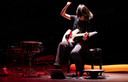
Li He, NODES 2024
© MUTESOUVENIR
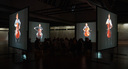
Stefan Streich, Vier Chelli, NODES 2024
© MUTESOUVENIR
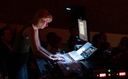
Jaqueline Butzinger, NODES 2024
© MUTESOUVENIR
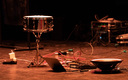
Berliner Lautsprecherorchester, NODES 2024
© MUTESOUVENIR
Review 2022
For the fourth time, the Studio for Electroacoustic Music organised the KONTAKTE festival on 16 September and from 22 to 25 September 2022. Featuring world premieres and revivals, the festival offered a multifaceted spectrum of current artistic trends and developments in the field of electroacoustic music and sound art. Over the course of five days, the entire Akademie venue on Hanseatenweg was brought to life with concerts, performances, sound installations and panel discussions. KONTAKTE '22 explored fundamental questions relating to electroacoustic music, as well as its artistic production and reception.
The festival continued its close collaboration with artists from Berlin’s independent scene, as well as from German-speaking and international regions, including ensemble mosaik, Lange//Berweck//Lorenz, Trio Pony Says and the Female Laptop Orchestra. Once again, partnerships were established with, amongst others, the Institute for New Music KLANGZEITORT, the Berlin University of the Arts (UdK), the Hanns Eisler School of Music Berlin (HfM), the TU Berlin and the German Society for Electroacoustic Music (DEGEM).
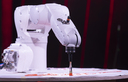
Nessun Dorma (2021), KONTAKTE 2022
© MUTESOUVENIR
Nessun Dorma (2021)
On the question of how humans will coexist with artificial intelligence (AI) and robots in the future, the theatre provided a testing ground where emotions, longings and fears could literally be acted out. With Nessun Dorma, the opera department is breaking new ground: whilst an old tape of death arias played in the background, the industrial robot ARKA created works of art during the day. ARKA encountered a cleaning robot working there: PUTZINI. The two loved and suffered, as befits a dramatic operatic narrative, discussing imitation and authenticity in art, as well as love and betrayal.
Conceived and realised by director Elsa-Sophie Jach, set designer Thea Hoffmann-Axthelm, creative technologist Markus Schubert and creative engineer Sebastian Arnd. With the support of Robert Bücker (physicist/problem-solver) and music by Antoine Daurat and Roberto Fausti.
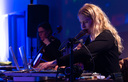
Female Laptop Orchestra, KONTAKTE 2022
© MUTESOUVENIR
Female Laptop Orchestra
Following performances in Melbourne and Zagreb in 2019, the Female Laptop Orchestra (FLO) continued its collaboration with the Japanese dance artists Fumi Tomioka, Aki Kawashita and Hiromi Hijikata, exploring telematic music-making inspired by movement and made possible by the internet.
For the performance as part of KONTAKTE '22, a selection of dance videos depicting “the landscapes within and beyond us” was streamed to Berlin and mixed and spatialised with sound textures produced both locally and remotely, featuring flute, trumpet, cello, piano, percussion, live electronics, voice and soundscapes.
Review 2019
Over the course of five days, KONTAKTE '19 presented a multifaceted spectrum of current trends in electroacoustic music, featuring over 70 works, more than 20 world premieres and around 120 artists. Particular emphasis was given to new productions that embrace performing arts and bring together sound, installation, performance, choreography and theatre in a cross-disciplinary manner. The festival centred on human and musical interaction.
A key part of the programme were Berlin-based initiatives dedicated to international cooperation and exchange. These included the 2019 “Progetto Positano” funding scholarship awarded by ensemble mosaik, a concert by the Kammerensemble Neue Musik featuring musicians from Shanghai, and the T.I.T.O. Marathon – featuring a line-up of 14 of the world’s most exciting turntablists at present – which brought KONTAKTE '19 to a close on the day of the Berlin Marathon.
The final instalment of the musical theatre trilogy Stadt Land Fluss by Daniel Kötter and Hannes Seidl celebrated its premiere, as did – for the first time in Germany – a new project by the French object theatre artist Laurent Bigot. Further highlights included two staged productions by Helmut Oehring, immersive performances by Thomas Ankersmit and Francisco López, and new works by Chengbi An, Beatriz Ferreyra, Hanna Hartman, Mesías Maiguashca, Robin Minard, Caspar Johannes Walter and others.
The festival opened with the Ensemble Garage performing compositions from the circle of Cologne’s Feedback Studio. The Feedback Group was founded in Cologne – an international centre of gravity in the 1970s – by Johannes Fritsch, Rolf Gehlhaar and David Johnson, under the guiding principle of “exploring and expanding forms of musical communication”.
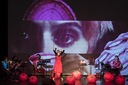
Julia Mihály, KONTAKTE 2019
© MUTESOUVENIR
Progetto Positano
Progetto Positano is a funding scholarship for young composers, launched in 2017 by the Ernst von Siemens Music Foundation in collaboration with ensemble mosaik: each year, two fellows are invited to live and work for a month at Casa Orfeo, run by the Wilhelm Kempff Cultural Foundation in Positano on Italy’s Amalfi Coast.
Following the residency in Italy, ensemble mosaik presents the works of the respective fellows in a double-portrait concert in Berlin. Previous fellows were: Johan Svensson (2017), Manuel Rodríguez-Valenzuela and Andreas Eduardo Frank (2018), Julia Mihály and Óscar Escudero (2019).
Review 2017
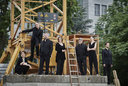
Neue Vocalsolisten, KONTAKTE 2017
© Martin Sigmund
For four days, the Akademie der Künste on Hanseatenweg was transformed into a vast experimental laboratory, hosting concerts, sound installations, artist talks and workshops. In its second edition, the festival became a hub for electroacoustic music and sound art, featuring 28 world premieres and first performances, and more than one hundred artists from 27 countries.
A historical focus of the programme was Hermann Scherchen’s Electroacoustic Experimental Studio in Gravesano. Highlights included three new productions by Wolfgang Heiniger, Kirsten Reese and José María Sánchez-Verdú, which premiered in two concerts with the ensemble ascolta and the Neue Vocalsolisten, incorporating Hermann Scherchen’s rotating zero-beam loudspeaker.
In addition, there were new productions of electronic sound art that explored the creative process and the interplay between music and research as driving forces, including works by José Manuel Berenguer, Christina Kubisch, Hans Peter Kuhn and Gerriet K. Sharma. A new CD and the launch of a new composition prize by the German Society for Electroacoustic Music (DEGEM), as well as artist talks in which the thematic focus of KONTAKTE '17 was discussed, rounded off the programme.
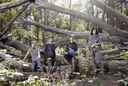
Femmes Savantes, KONTAKTE 2017
© Anja Weber
The long-standing partnerships with he German Society for Electroacoustic Music, the DAAD Artists-in-Berlin Program, the Berlin University of the Arts, the Hanns Eisler School of Music Berlin and the Technical University of Berlin were expanded this year to include new collaborators such as Lebenshilfe Berlin and the Berlin-based initiative Heroines of Sound.
The four-day programme of events was accompanied by an exhibition featuring materials from the Hermann Scherchen Archive, as well as a wall installation from Johanna Diehl’s series Das imaginäre Studio (The Imaginary Studio), which explores the equipment used in post-war electronic studios, including Scherchen’s legendary zero-beam loudspeaker. Special international guests included the National Laboratory of Electroacoustic Music (LNME) in Havana, Cuba, which presented a new concert project in co-production with Cuban artists.
Review 2015
The first edition of KONTAKTE featured current trends in electroacoustic music and sound art of international standing, aimed at a wide audience and provided a forum for debate and reflection on musical thought in the age of communication. The festival’s revival was marked by a festive occasion celebrating the 80th birthday of its original founder, Georg Katzer, who launched the event series in the 1980s.
The programme, running from 25 to 27 September, combined world premieres, works by the classical avant-garde, chamber music and live electronics, and filled the entire Akademie building on Hanseatenweg with concerts, sound installations, performances and films. In addition, Georg Katzer’s CD Elektroakustische Kompositionen aus vier Jahrzehnten (Electroacoustic Compositions from Four Decades) and the DEGEM CD Grenzen (Frontiers) were presented exclusively. The festival programme was complemented by workshops, artist talks and a panel discussion.
The fusion of tradition and modernity played a key role. Valerio Sannicandro’s spatial composition Ephemeris premiered and could be heard and seen from both sides of the studio hall at the Akademie der Künste. New works were presented by, amongst others, the composer Hans Tutschku and the Lebanese improvisational musician Mazen Kerbaj. In contrast, exceptional works and rare historical documents from the 20th century by Boris Blacher, Roberto Gerhard, Hermann Scherchen, Karlheinz Stockhausen and others were performed.
Further highlights of the festival included Peter Vogel’s legendary Shadow Orchestra and the preview screening of the film The Subharchord. Open calls and composition prizes, organised by the partner institutions, provided inspiration for the work of emerging artists; the winning works were integrated into the programme. The guest countries at KONTAKTE '15 were Mexico and Canada.
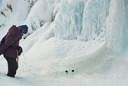
Karen Power, KONTAKTE 2015
© John Godfrey
Karen Power, Sounding Water (UA)
In Sounding Water, Karen Power combines her interest in field recordings, the natural rhythms of our world, musical structures and spaces to create a partly improvised, partly composed laptop performance exploring water in its many different states. This live electronic performance highlights the many audible and inaudible qualities of water in all its various states – from frozen Arctic ice water to the flowing Irish Blackwater River, right through to the deafening underworld of the Laotian rice paddies.
Karen Powers’ partly improvised pieces create, in a unique way, soundscapes that are both real and imaginary, through which the audience can wander and explore. She specialises in using audible and inaudible ambient and everyday sounds, which she has recorded around the world, as catalysts for constructing diverse sound paths and landscapes that could not physically coexist outside the performance space she creates.
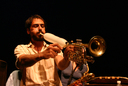
Mazen Kerbaj featuring Rabih Beaini, Multiplied (world premiere), KONTAKTE 2015
© MUTESOUVENIR
Mazen Kerbaj, Multiplied
Multiplied is an 8-channel improvisation for trumpet and live modular set, produced by the Studio for Electroacoustic Music at the Akademie der Künste in collaboration with the DAAD Artists-in-Berlin Program.
Mazen Kerbaj is a Lebanese comic artist, visual artist and musician, born in Beirut in 1975. He also works on selected illustration and design projects and has taught at the American University of Beirut. Kerbaj is the author of 15 books, which have been translated into more than ten languages, and his works have been exhibited in galleries, museums and at art fairs worldwide. He is widely regarded as one of the pioneers and key figures of the Lebanese scene for free improvisation and experimental music. As a trumpeter, he pushes the boundaries of the instrument beyond recognition.