Display Depot Architectural Models
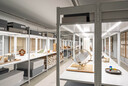
Shifting perspectives and redefining dimensions, at least on a small scale: the permanent Display Depot Architectural Models exhibition invites visitors to explore architectural ideas through objects.
A Visionary Power that Continues into the Digital Age
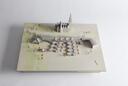
Architectural models fascinate with their vividness, variety of materials and, above all, their visionary power. Even in the digital age, they have not lost their significance as three-dimensional work tools, competition entries or presentation objects. Despite sophisticated digital techniques for designing and presenting spaces virtually, they continue to play an essential role in the daily work of architectural offices, especially in the development of ideas.
The architectural models in the display depot inspire visitors to explore the ideas and hopes that drove architecture and urban planning in the past, to trace the designs that shaped today’s cityscape and, last but not least, to ask in what kind of city do we want to live in the future.
From the 18th Century to the Present Day
In the visible storage, a wide variety of architectural designs and visions are waiting to be discovered: from the 1786 replica of the Roman Arch of Septimius Severus, used for educational purposes, to the colourful glass building game Dandanah, a toy designed by Bruno Taut in the context of the reform movement in the 1920s, to urban planning models of Berlin spanning the period from the city’s reconstruction after the Second World War through to the present day.
The projects range from urban design in Berlin by Hans and Wassili Luckhardt, Ludwig Leo and Heinz Graffunder to innovative energy concepts by Walter Schwagenscheidt, Tassilo Sittmann and Jörg Schlaich, to contemporary experimental construction projects by Karla Kowalski, Regine Leibinger and Frank Barkow.
Also represented are internationally influential architects such as Hans Scharoun with his concert halls and theatres, Bruno Taut with the Monument des Eisens (Monument of Iron) and the Haus Dahlewitz (Dahlewitz House), and Konrad Wachsmann with models of his “nodes” for aircraft hangars.
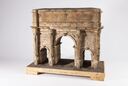 Archo di Settimio Severo / Triumphal Arch in Rome, designed by Antonio Chichi, ca. 1786, Architekturzeichnungen und Modelle der Preußischen Akademie der Künste Nr. 1© Akademie der Künste / photo: Maximilian Merz (2024)
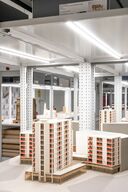 High-rise building at Kottbusser Tor, designed by Hans and Wassili Luckhardt, after 1952, Akademie der Künste, Archiv Nr. 299© Akademie der Künste / photo: Andreas [FranzXaver] Süß
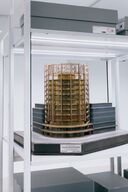 Haus Berlin, designed by Hans and Wassili Luckhardt and Alfons Anker, before 1931, Luckhardt-und-Anker-Archiv Nr. 293© Akademie der Künste / photo: Jonas Holthaus (2024)
 Glass building blocks Dandanah, reform toy designed by Bruno Taut, 1920/21, Akademie der Künste, Bruno-Taut-Archiv Nr. 1038© Akademie der Künste / photo: Andreas [FranzXaver] Süß