Picture Cellar
The preserved murals by the master students of 1957–58 in the coal cellar of the Akademie der Künste venue at Pariser Platz are unique testimonies to the youthful opposition in East Berlin art.
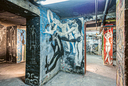
Uninhibited Scenes Express Artistic Freedom
During the turbulent period of the 1950s and 1960s, heated debates arose over the generation of master students, including Manfred Böttcher, Wieland Förster, Dieter Goltzsche, Harald Metzkes, Ernst Schroeder, Werner Stötzer and Horst Zickelbein. It was a cultural-political campaign against the members of the Akademie in the GDR.
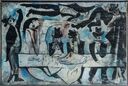
The generation born in the 1930s played a particularly significant role in shaping the “Berlin School”. They were interested in a form of realism that differed from the state’s demands. Terms such as “obscure” and “untimely” used to describe their “canned art” are typical examples of the press campaign they faced.
Outside pressure and the inner processing of the post-war period brought the artists closer together and prompted them to respond with their “black” paintings. This is where the desire to experiment was unleashed, fuelled by a large pot of black paint. Uninhibited scenes populate the walls of the cellar – here, the artists let loose in a way that would not have been possible in public exhibitions.
Interview films with Jürgen Böttcher, Dieter Goltzsche, Harald Metzkes, Werner Stötzer, and others, as well as insights into the work of the restorers, are shown in the cellar space. The media station provides audio documentation of the debates of the time in the form of interviews with contemporary witnesses, including Fritz Cremer, Paul Dessau, Helene Weigel, and Arnold Zweig.
The Picture Cellar can be visited every Wednesday as part of a guided tour; advance booking is required.
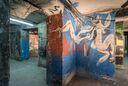 Akademie der Künste, Picture Cellar© VG Bild-Kunst, Bonn 2024 / photo: Andreas [FranzXaver] Süß
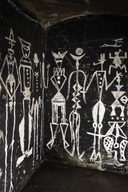 Akademie der Künste, Picture Cellar, mural by Manfred Böttcher© VG Bild-Kunst, Bonn 2024 / photo: Andreas [FranzXaver] Süß
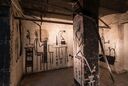 Akademie der Künste, Picture Cellar, mural by Manfred Böttcher© VG Bild-Kunst, Bonn 2024 / photo: Andreas [FranzXaver] Süß
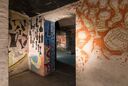 Akademie der Künste, Picture Cellar© VG Bild-Kunst, Bonn 2024 / photo: Andreas [FranzXaver] Süß