Procession into the Eco-Liminal
Petja Ivanova
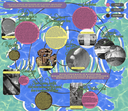
Artwork
Climate crisis is often described in terms of data, damage and future risk. Petja Ivanova’s work approaches it from the angle of presence: the perceptual conditions that have allowed land to become an object to be exploited. In her work Procession into the Eco-Liminal this crisis is explored through the senses: it asks how a body can become situated again and whether ecological responsibility might arise from the capacity to allow touch.
The performance Procession into the Eco-Liminal took place in August 2024 in the Saeva Dupka cave in Bulgaria. Acknowledging its symbolic value and the fact that the magical and metaphysical has a material reference, the cave acts as an active site of transformation where body, geology, sound, darkness, moisture, psyche, performers, audiences and movement enter into relation with one another. The cave in this work is not to be understood as a stage but as an entry point into the experience and concept of “eco-liminality”.
The eco-liminal describes a state of transformation in which the self becomes porous to the forces that surround it. More than a passage between one state and another; eco-liminal is the condition of life itself: Growth, decay, adaptation, healing, grief and becoming all happen through threshold experiences. To be alive is to be repeatedly changed by what we come into contact with.
Philosophically, the eco-liminal can be regarded as a space prior to fixed meaning. It belongs to a non-verbal and pre-conceptual register: a state in which knowledge is not yet organised as language, category or explanation but is felt as atmosphere, pressure, rhythm, orientation, limitation, intensity or bodily response.
Ivanova’s work engages these zones through what she calls geo-somatics: an artistic methodology for sensing the impact of landscapes on the body and for developing practices of bonding with the living world. Geo-somatics does not approach land as an object of observation but as a force that participates in subject formation. This marks a movement away from positivist and Cartesian models of knowledge, in which the world is divided into observing subject and observed object, mind and body, culture and nature, reason and feeling.
Procession into the Eco-Liminal proposes that knowledge that arises through somatic resonance is a facet of ecological intelligence. These are aspects of psychic and embodied forms of knowing that have often been marginalised by Western and imperial knowledge systems because they do not easily submit to measurement, extraction or control. In this respect, they challenge the epistemic practices that treat land as an available resource.
A positivist relation to land depends on distance. It trains the observer to separate themselves from the observed, to classify before relating, to measure before being touched. This distance is not neutral. It is not innocent and artless but rather learned. Geo-somatics works against this conditioning. It asks what becomes possible when land is felt as an active subjectifying force, as something that is involved in the formation of the self, without having human qualities projected onto it.
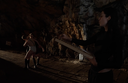
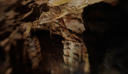
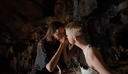
Geo-somatics means recognising that a place already acts on us and through us. Which is why embodied and psychic forms of knowing have become politically important. They interrupt the conditions that sustain extractive relations. They make it harder to approach land as inert matter. They cultivate attachment, response, vulnerability and care. They open up a mode of perception in which being affected by place becomes a form of knowledge, and where relation becomes the ground for ecological responsibility.
Procession into the Eco-Liminal is a work that helps us step into this altered relation. In the cave, the human body is not the sovereign force that gives meaning to the landscape. The performance asks what happens when the Human is no longer the central agent but one participant within a wider field of forces. The place – the cave – intensifies this question as it is not simply a geological formation: caves are thresholds in the history of perception. In the cave, the human encounters its own process of becoming through darkness.
Procession into the Eco-Liminal invited the audience and performers to engage in an experience in which art opens the individual up to place. To be touched by place, altered by atmosphere, unsettled by darkness or moved by sound is not a loss of self. It is an opening into ecological subjectivity.
The following people helped bring the performance to fruition: Petja Ivanova, Camilla Strandhagen, Alexandra Gruebler, Nicole Bettencourt Coelho, Sarah Kantrowitz, Natalia Jordanova, Vasil Hristov. It was made possible with the support of ifa – Institut für Auslandsbeziehungen and the Singer Zahariev Foundation.
Visit the website: Procession into the Eco-liminal | Poeticfutures
Petja Ivanova was the recipient of the 2022 Human Machine Fellowship awarded by the JUNGE AKADEMIE at the Akademie der Künste.