The Risk of Openness
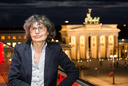
Manos Tsangaris and Anh-Linh Ngo in conversation with Akademie member Cécile Wajsbrot
Cécile Wajsbrot writes in the interstices of spaces and times, languages and memories. In conversation, she explores risk as literary practice that operates beyond the habitual: as adventure, as a willingness to endure uncertainty and doubt, to keep meanings open, and to assert oneself against the reductions of the present. In other words, literature as a counterpoint to the language of simplification prevalent in the discourse of society today.
Interview
When people talk about risk today, it is normally in an economic sense, having to do with calculations, forecasts or probabilities. Literature, on the other hand, seems to have a different relationship to uncertainty. For you personally, what role does risk play in writing?
Risk is an inherent part of writing, and of creating in general. In literature it is no different than in the other arts. What good is another book on the bookshop tables if it does not at least make an attempt to open up new horizons? Of course I may fail in the process. But for me, pure reproduction is not an option. Every book, every novel is a challenge. How do form and content come together? It’s different each time. And that is precisely where the risk lies, because there is no recipe to fall back on.
In your literary work, voices overlap, narratives remain open, and meanings shift. Does this openness present an aesthetic risk, in your opinion, or is it actually a prerequisite for literary insight?
Both. I do indeed work with voices: anonymous voices, inner voices; I work with layers and superimpositions, with everything that is not linear. I have no interest in writing a novel that has a beginning, middle and end, that develops smoothly and chronologically. Boring to write, boring to read. I try to find new forms that are befitting of our times. In the words of Hugo von Hofmannsthal, “Form is the sense of content; content the essence of form.” Form is not just form. The content is part of it. But focusing solely on action or plot is an academic exercise. With writing, on the other hand, there is always an element of adventure. That’s what you call “aesthetic risk”. Therein lies the beauty of it, in my eyes.
You work not only as an author but also as a translator. In novels like Nevermore, translation itself becomes a literary theme. What is at stake in translating?
I often say that in translation, the unit of measurement is not the word but the sentence. That can also be understood in symbolic terms: it is not the text but rather the context that is crucial.
Translation is a beautiful activity because it creates access. Access to other ways of thinking, to different cultures, which would otherwise remain closed to us, since we cannot learn and understand all the languages of the world. That’s why I take issue with the current debate about who should be allowed to translate what. Putting yourself in different contexts is precisely what translating is all about. Why should that be restricted to people who share the same culture or background? The notion that some kind of credentials are required for translating strikes me as entirely inappropriate. Translating means opening, not closing. This has nothing to do with cultural appropriation.
You describe yourself as someone who moves between languages, countries and affiliations. Do you see this in-between as presenting more of a risk or as a prerequisite for writing?
As an expansion of horizons that is not without risk. In such in-between spaces, it’s easy to lose your equilibrium. But this discomfort is part of it. Even before I lived between Paris and Berlin, I had the feeling of being “in between”, of not quite belonging, either socially or culturally. In a certain sense, my current way of life is better suited to this existential situation.
You once said that you don’t write about the past itself but rather about its resonances in the present. Is that also a form of resistance against society’s need to bring the curtain down on history?
The question relates primarily to my early books. Over the past twenty years I’ve also written about other topics: ecology, art, migration. That too is a risk. For a long time my work was pigeonholed, especially in Germany, as “dealing with the past”, and it is sometimes still reduced to this, regardless of the particular topic. Imre Kertész once wrote that even when he isn’t writing about Auschwitz, he is still writing about Auschwitz. In my case, I don’t think that’s true at all. Of course, I come from that history; it’s part of my family and it has shaped me. But I’ve always attempted to free myself of it or, more precisely, to move freely within it. That meant – and this was something I was already doing when I wrote La Trahison or Mémorial – and still means maintaining the right distance. Not ignoring the past, as was long the case in France, but at the same time not being mesmerised by it. Where we come from is not the only thing that defines us. And to the degree that it shapes us, we need to understand what that means.
Writers do not live on a different planet or in another time dimension. Our task is to bear witness, to open up other perspectives onto our present, not as newspapers or social media do but in a literary way. That’s why, in my books, I try to capture an entire span of time: past, present and future, and not necessarily in chronological order.
In your texts, these times overlap. How do you work with the uncertainty of memory and the openness of meaning in your writing?
Literature is about nuances. And today, with society becoming ever more polarised and radicalised, I find that particularly important. In this respect, literature should set up a counterpoint. This does not mean relativising everything but rather depicting nuances, unfolding a spectrum, making diversity visible.
Your question addresses an important point: uncertainty. It’s something that literature deals with. Not the harsh light of the midday sun, which overwhelms everything and washes out the colours, but rather the diffuse, gentle evening light, in which the entire range of colours ultimately becomes visible. This does not mean that the content also becomes diffused. My novel Destruction is about a dictatorship in France. I expressly wanted the country of France and the city of Paris to be named. In dystopias, locations often remain undefined, imaginary, or are set in distant worlds. I wanted to go against that: it can happen hic et nunc – here and now. In this dictatorship, bookstores are closed, art is banned, and only entertainment is allowed. To a certain extent, we are already seeing this, albeit in a different form. Dictators don’t only have names from the past or that sound foreign; they can also have German names, specific names. Culture is being destroyed – not only in eastern Europe but in western Europe as well. Literature, on the other hand, has the ability to express things not only through language but also through rhythm, imagery and the power of imagination. This can have a deeper impact.
Do you have something like criteria for uncertainty in writing?
Doubt is a lifelong companion.
Current cultural policy increasingly regulates uncertainty – through guidelines or codes of conduct, for instance. Spontaneous statements are considered a risk. What is your take on this development? And what are the implications for literature and art when unpredictability is no longer considered a necessary characteristic of public discourse but is instead avoided? Does this indicate a lower willingness to accept risk as a prerequisite for change?
As I mentioned earlier, society is becoming polarised, and positions are becoming more entrenched. While social media certainly contributes to this, it is merely amplifying thoughts that already exist. Perhaps there is a certain logic to this: the more complex the world becomes, the simpler and the more radical are expected to be the answers to the questions raised. This is extremely dangerous. Every statement is observed, commented on – often aggressively – and, in the process, heavily simplified. We should not, however, mistake caution for nuance. Our complex world demands complex answers. In this complexity lies the material for art and literature. Art is like a compass. Although it points northward, it does not ignore the other directions. The needle vibrates, searches …
At a time when simple answers are demanded in the face of the climate crisis, wars, displacement, death and destruction, many respond with fear, turning to far-right parties or simplistic ways of making sense of the world. It is reassuring to believe that one can clearly distinguish between good and bad. This language of simplification is no longer just American or Russian; it is also Hungarian, Italian, German and French. At the same time, it is becoming clear that the lessons of history only go so far. We believed that memory could protect us. It has made a great deal possible, including the building of Europe. But memory is fleeting. That is the first lesson of the 21st century. Memory alone does not suffice, not least because we cannot read the present through the lens of the previous century. We are a little like young Redburn in Herman Melville’s eponymous novel, navigating a changed city with an old map. Time moves on. That is unsettling, because we need to find new ways forward, in society as in art.
What do you see as the biggest risk in writing today?
The real danger in writing, as in life, is habit. Interestingly, risk can mean both experiment and threat. To me it means, in a positive sense, always searching for something. At all events, the risk of fiction is something that should be emphasised today. In a world that constantly demands authenticity, while at the same time fake news and AI images circulate freely, fiction has become a rarity. And yet it is neither reality nor deception but instead a form of interpretation. Perhaps it is the only way to make the complexity of the world fully legible.
Cécile Wajsbrot, writer and translator, has been a member of the Akademie der Künste’s Literature Section since 2019 and its deputy director since 2021.