Who is Inside and Who is Outside? Reflecting on Borders
Regine Keller
Essay
As I write these lines, I don’t know whether the borders I’m familiar with today will still exist when this essay is printed. Leafing through my old school atlas from the 1970s, I realise how much has changed. Although I was frightened by the “leaden times” of those years, it did not stop me from foraging for mushrooms in the woods between the Palatinate and Alsace. That wonderful forest seemed boundless to me, and the mushrooms didn’t care which country they grew in during the “German Autumn”.
There has always been an awareness in Germany, both East and West, of how fraught these stretches of country along political borders can be.
Sometimes I wonder whether we wouldn't be better off without borders. What could replace the need to protect oneself and the interests of one’s own people? Would the disappearance of borders grant us, as world citizens, the “eternal peace” envisioned in international law (Immanuel Kant, 1795)? Although I have studied politics and international law, I do not feel qualified to offer an expert opinion on that matter. My perspective is that of a simple gardener and landscape architect. I wonder if landscape and garden can be read as metaphors for the way we deal with borders. Could the notion of a borderless landscape serve as a catalyst for a supranational understanding of ourselves in how we interact with our planet?
Landscape – commons or property
If landscape were a person, it would not know the phenomenon of borders. Landscape areas are shaped by their differing geology and tectonics, as well as by the influences of climate and vegetation. Many landscape features – such as rivers, coastlines, and mountain ranges, as well as vegetation zones such as forests and deserts – extend across borders. Because they span national borders, many of these areas have been designated by UNESCO as nature or biosphere reserves.1
Such spaces embody an effort to protect landscapes beyond the scope of national jurisdictions. The fact that the major superpowers are increasingly withdrawing from these international organisations speaks volumes.
The emergence of borders in natural environments is in many cases historically tied to the cultural techniques humans have developed to utilise the Earth’s resources and manage its surface. These cultural landscapes are inextricably linked to the work humans do on “nature”.2 With the agricultural revolution, the rise of arable farming and animal husbandry not only transformed the character of the landscape but also led to the introduction and demarcation of boundaries. In the Middle Ages, these “boundary markings” stood under the protection of margraves.
Over many centuries, the rural population in Europe had shared use of pastures and forests as commons, for example in the form of pastoral forests. In the 17th century, large landowners began taking these areas away from the small farmers. These lands were enclosed – in Britain and southern Germany, in particular – denying the rural population access to areas they had previously relied on for subsistence. The consequence of the so-called Enclosure Movement was a dramatic impoverishment of small farmers. Karl Marx would later describe this process as the “expropriation of the rural population from land and soil” and as a precondition for capitalist modes of economic production.3 The communal usage and management of resources that had functioned for centuries was brought to an abrupt end by land appropriation and the drawing of boundaries in the landscape. Today’s commons movements seek to revive this idea of land and resource ownership oriented toward the common good.4
“I walk further into the landscape, which has no other task than to wait for the human being to disappear.”5
Access to resources like clean water and healthy soil is central to today’s struggle for a socially just and sustainable use of our planet. It is also an aspect of human rights as recognised in 2010 by the United Nations General Assembly.6 In this context, the idea of understanding landscape features – such as rivers – not merely as objects but as living entities with whom we co-exist , and thus as legal persons, marks a fundamental shift in perspective in how we relate to the foundations of life on the planet.7 However, free access to clean resources such as water can only be ensured if territorial borders play no strategic role. This is precisely what political actors exploit, as we are reminded time and time again.
Back in 1972, the report The Limits to Growth warned of the need to regard the preservation of a liveable environment as a transboundary, planetary, and thus shared rather than competitive task.8 This remains the order of the day. National borders run counter to this idea. Or should we instead retreat behind the local boundaries of our own garden fence?
What is the fox doing in the garden?
How sensible it can be to fence off a garden becomes clear at the very latest when you forget to close the garden gate. The fox has stolen the goose, deer have nipped off the flowers, and wild boar have ploughed up the carefully tended garden. What is left? The now pointless border, the open garden gate – and the realisation that simply closing the gate will not restore the garden.
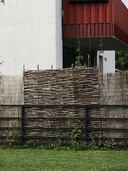
Such a mishap shows the practical use that boundaries can have. Protecting what is cultivated from untamed nature has always been the purpose of the garden. This is indicated by its etymology: the word garden (Old English geard, Old High German garto, French Jardin; cognate with yard and guard) refers to a plot of land enclosed with willow fencing. In such an enclosed garden (Lat. hortus conclusus), one can experience a place protected from the outside world: a place of culture, retreat, contemplation, innocence or desire. It is an exclusive place. The walled pleasure garden (Lat. hortus deliciarum), by contrast, was idealised in the Middle Ages as a setting for courtly life that appealed to the senses. In literary works such as the chivalric romance Le Roman de la rose by Jean de Meun and Guillaume de Lorris or Francesco Colonna’s dream narrative Hypnerotomachia poliphili, gardens appear as concentrated sites of longing and as encoded socio-philosophical designs. They were influenced, among other things, by travel accounts of Persian gardens, whose high art consisted of creating an earthly paradise through lush planting and ingenious irrigation.
It is no coincidence that the Greek word parádeisos, from which the English word paradise is later derived, corresponds to the Middle Persian word pardēz meaning garden (Hebrew pardēs), which in turn can be connected to the Avestan word pairidaēza, meaning enclosure. Put simply, the gardens of paradise laid out behind medieval walls can be read as architectural interpretations of the multivalent texts of the Old Testament. Here the same language is used as that transmitted from Babylonian and Old Persian texts: “A river flowed out of Eden to water the garden” (Genesis 2:10); “A garden locked is my sister, my bride, a spring locked, a fountain sealed” (Song of Songs 4:12); “And I will make … all your wall of precious stones” (Isaiah 54:12); “You shall call your walls Salvation” (Isaiah 60:18).9
The New Jerusalem in the Book of Revelation was also a vision protected by walls, one that, from the Middle Ages onward, manifested itself in the architecture of cities, churches, monasteries and in garden design.10 Those who had no right to seek protection within the community inside these walls, or who were even outlawed, had to remain outside and were considered beyond the protection of the law. This is how this understanding of boundaries has become inscribed in us.
If walls signify “salvation”, what then happens outside?
Yet boundaries no longer seem to offer protection. The reliability of defined zones and alliances – whether physical, political or social – is dissolving. The current violations of borders by the superpowers constitute a new geopolitical situation that is putting ideas such as the European Union to the test.
At present, there are some 250,470 kilometres of political borders worldwide, of which roughly 26,000 kilometres consist of walls and fences. The inner German border was just under 1,400 kilometres long, and the Berlin Wall divided the city along 155 kilometres. Its fall heralded the end of the Soviet Union – a development that Putin today describes as the “greatest geopolitical catastrophe of the 20th century”.11
The new narratives of the superpowers revolve around restoring old borders and shifting existing ones. There is no negotiation – only deals being struck or bombs being dropped. Who is inside and who is outside?
How could this be countered? Can open countryside serve as a social metaphor for developing a new narrative? The unifying force of borderless landscapes would then be not merely a physical phenomenon but a political concept: the idea of an enlightened social construct.
Perhaps a different way of thinking about borders begins where spaces are used without being owned. What we need is a kind of mushroom-foraging in the borderlands, where the sense of belonging arises not from passports, property and national appropriation but from shared responsibility. Landscape would then not be a territory but rather a space for coexistence.
The ecological perspective on landscape exposes the fiction of political borders. Those who close, shift or militarise borders today act against the material conditions of our coexistence. For the planet, there is no inside and outside. It can only be inhabited together or destroyed together.
Translated by Peter Rigney
Regine Keller, landscape architect and urban planner, has been a member of the Akademie der Künste’s Architecture Section since 2013 and its deputy director since 2024.
References
- “Biosphärenreservate”, UNESCO, https://www.unesco.de/orte/biosphaerenreservate/ (accessed 20 Jan. 2026).
- Ludwig Fischer, “Kulturlandschaft und Arbeit: Nachdenken über das Selbstverständliche”, in Markus Leibenath, ed., Wie werden Landschaften gemacht?, Bielefeld: transcript, 2014, pp. 39–60.
- See Eva von Redecker, Revolution für das Leben, Frankfurt am Main: S. Fischer, 2020, pp. 26.
- See “Commons”, Heinrich Böll Stiftung, https://www.boell.de/en/topics/commons (accessed 12 Jan. 2026).
- Heiner Müller, “Der Mann im Fahrstuhl” monologue in “Der Auftrag,” in Frank Hörnigk, ed., Werke 5: Die Stücke 3, Frankfurt am Main: Suhrkamp, 2002, p. 33.
- “Menschenrecht auf Wasser und Sanitärversorgung”, UN-Menschenrechtsabkommen, https://www.menschenrechtsabkommen.de/menschenrecht-auf-wasser-und-sanitaerversorgung-1128/ (accessed 13 Jan. 2026).
- Robert Macfarlane, Is a River Alive?, New York: W. W. Norton, 2025; see also Klaus Bosselmann and Timothy Williams, “The River as a Legal Person: The Case of the Whanganui River in New Zealand”, 29 Jan. 2025, https://www.boell.de/de/2025/01/28/der-fluss-als-rechtsperson-das-beispiel-des-whanganui-river-neuseeland (accessed 20 Jan. 2026).
- Donella H. Meadows, Dennis L. Meadows, Jørgen Randers and William Behrens III, The Limits to Growth: A Report for the Club of Rome’s Project on the Predicament of Mankind, New York: Universe Books, 1972, https://www.clubofrome.org/publication/the-limits-to-growth/ (accessed 13 Jan. 2026).
- See Christina Steinmetzer, “‘Hortus conclusus’, das Janusgesicht des Gartens im Mittelalter”, University of Salzburg lecture series, Winter Semester 2001/2, https://www.plus.ac.at/wp-content/uploads/2021/02/544731.pdf (accessed 13 Jan. 2026).
- See Revelation 21:1–2.
- See Felix Riefer, “Die Erzählung vom Ende der Sowjetunion als außenpolitischer Referenzpunkt”, APUZ, 21–22 (2017); available online from bpb, https://www.bpb.de/shop/zeitschriften/apuz/248508/die-erzaehlung-vom-ende-der-sowjetunion-als-aussenpolitischer-referenzpunkt/#footnote-target-4; see also Michael Thumann, “Regime der Ravanche”, Internationale Politik, 3 (May/June 2023), https://internationalepolitik.de/de/regime-der-revanche (accessed 20 Jan. 2026).