Opening Address by Anh-Linh Ngo at the launch of “Re:Create Europe”
With an online kick-off meeting, bringing together over 100 participants, the European Alliance of Academies launched the four-year project “The Art of Resilience and Resistance: Empowering artists and cultural professionals tackling new challenges in Europe”.
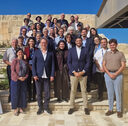
The project is supported by a large-scale grant under the Creative Europe programme of the European Union and will run from 2026 to 2029.
The meeting marked the official beginning of the project. The partner consortium introduced their perspectives and outlined their visions for the upcoming four years. Under the 2026 annual theme “Transformation of Cultural Policies”, the consortium presented the conceptual framework for the first project year and introduced the planned activities within the different work packages.
Read the opening address by Anh-Linh Ngo, Vice-President of the Akademie der Künste, here:
Dear colleagues, dear members of the European Alliance of Academies,
It is a pleasure to welcome you – also on behalf of Manos Tsangaris, who cannot be with us today.
We are meeting at a moment when artistic freedom in Europe is increasingly being challenged from within the political system itself. In Germany, we are currently witnessing political interference in the leadership of major cultural institutions: attempts to influence decisions at international festivals, to question or intervene in jury processes, and to exert pressure based on perceived political positions. At the same time, funding decisions are being prepared that could significantly weaken cultural institutions, often without transparent reasoning. This is not business as usual, and it is not just a national issue. It signals a shift from supporting cultural autonomy to managing and steering culture politically.
The urgency of our meeting follows directly from this situation. What is at stake is not only cultural policy, but the conditions under which artistic freedom – and with it democratic freedom – can exist.
Our project, RE:CREATE EUROPE, addresses precisely this question: the cultural conditions that will determine whether Europe has a future. Europe is facing external threats: war, authoritarian regimes, geopolitical tension. At the same time, it is under pressure from within: through polarization, through the loss of shared reference points, and through the erosion of a public sphere in which these can be debated. Europe no longer has sovereignty over the spaces where public debate takes shape today: digital platforms. What is eroding is not only trust; what is eroding are the forms of democracy.
Authoritarian politics understands this dynamic well. Its first target is institutions, because they carry the forms and rules that make democracy possible. Procedures are questioned, rules are ignored, and complex issues are reduced to simple narratives. At the same time, politics adopts tools that originate in the arts: staging, strong images, emotional storytelling. This is not accidental; it is strategic.
What emerges is a deeper divide: not simply between political camps, but between two kinds of public sphere – one democratic, based on debate, difference, and judgment; and another driven by emotion, simplification, and algorithms.
Judgment, however, does not arise on its own. It has to be learned; it grows through experience, practice, and cultural formation. Here the role of the arts becomes clear. They are society’s most sensitive instruments of perception, training how we see and understand the world. They function as a laboratory for a key human capacity: judgment. In the arts, we learn to look closely, to distinguish, and to weigh. Only those who develop this capacity can understand what freedom of thought means. Judgment is not abstract; it is a practice. And for that very reason, it can be weakened.
Against this background, the European Alliance of Academies takes on its full significance, and with it, RE:CREATE EUROPE. The project responds directly to the situation we face. It recognizes that artistic freedom in Europe is under pressure – from political intervention, economic conditions, and illiberal trends – and develops a response that is not national but European, not isolated but structural.
What takes shape here goes beyond cooperation. It is the beginning of an infrastructure of solidarity: networks that support each other in times of crisis, exchange across borders, and shared strategies that can lead to action. In this sense, RE:CREATE EUROPE strengthens Europe’s cultural public sphere.
Europe does not lack knowledge; it lacks a strong public sphere. There is no shortage of voices, but there is a lack of shared spaces where these voices can meet – spaces shaped by open debate rather than controlled by platforms. What is also lacking is the capacity to act together.
For this reason, we need what Manos Tsangaris calls a democratic league. This does not mean consensus. It means something more demanding: sustaining differences and still acting together when the foundations are at risk. This concerns states, institutions, and all of us.
Academies have a particular role to play here, not because they are more political than others, but because they work on something fundamental: forms. Forms of representation, forms of critique, and forms of public exchange. These forms determine whether democracy can function.
The central question, then, is: Who shapes the forms through which Europe understands itself? If these forms break apart, Europe loses its ability to act – politically and culturally.
RE:CREATE EUROPE is therefore more than a project; it is a test. Can networks become structures? Can exchange become commitment? Can solidarity become action?
The Akademie der Künste was founded 330 years ago, on the eve of the Enlightenment, in a time when form primarily served power. With the founding of institutions like the Akademie, something fundamental changed: form became a subject of critique. It had to justify itself and became the place where judgment is formed.
Today, we face a similar moment. The task is no longer critique alone. The task is to create forms that can sustain democracy.
RE:CREATE EUROPE can be part of this effort. The European Alliance of Academies can be its backbone. It is up to all of us whether this becomes more than a project: a structure that can contribute to Europe’s ability to act in uncertain times.
Thank you.
About the Project
“Re:Create Europe” is not only a support programme, but a clear institutional response to the growing pressures on artistic freedom and cultural autonomy across Europe. Artists and cultural professionals are increasingly working under conditions shaped by war and aggression, political instrumentalization, economic precarity, ecological collapse, and shrinking civic space. In this context, resilience cannot be understood as adaptation alone, but as a cultural, ethical, and civic responsibility.
Through a combination of mobility programmes, blended learning formats, onsite residencies, digital mapping, and international conferences, “Re:Create Europe” aims to empower artists and cultural professionals across disciplines and regions. The project strengthens transnational solidarity, supports artistic practice under conditions of crisis, and fosters exchange between institutions, practitioners, and policy-oriented cultural actors.
The partner consortium consists of Arts Council Malta, Croatian Association of Fine Artists, Academy of Fine Arts and Design Bratislava, Círculo de Bellas Artes de Madrid, National Academy of Arts Sofia, National Academy of Arts of Ukraine, Society of Hungarian Authors, Villa Decius Kraków and Akademie der Künste (Berlin).
“Re:Create Europe” marks an important next phase in the Alliance’s work to defend the conditions under which free artistic expression, critical reflection, and cultural exchange remain possible in Europe.
More information: www.allianceofacademies.eu
All documents are protected by copyright. The reprinting of texts and the copying of all other files is only permitted with the express permission of the Akademie der Künste or the authors themselves.