Anna Seghers Museum
The Anna Seghers Museum in Berlin-Adlershof houses spaces preserved in their original condition where the world-renowned writer lived and worked – including the library she bequeathed, containing some 10,000 volumes and many personal mementoes.
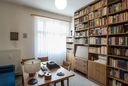
The Anna Seghers Museum
Akademie der Künste, Berlin © Photo: Andeas Süß, 2019
About the Museum
A small permanent exhibition on her life and work features photographs, documents and the valuable first editions of her books, along with original recordings that allow visitors to hear Seghers’s voice.
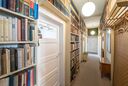
The Anna Seghers Museum
Akademie der Künste, Berlin © Photo: Andeas Süß, 2019
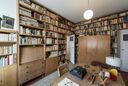
The Anna Seghers Museum
Akademie der Künste, Berlin © Photo: Andeas Süß, 2019

Bookcases in the Anna Seghers Museum
Akademie der Künste, Berlin © Photo: Andeas Süß
The Anna Seghers Museum in Berlin Adlershof preserves this writer's home and study as it was during her lifetime, and presents a permanent showcase exhibition on her life and work. The Museums original furnishings include Anna Seghers' extensive private library and many personal mementoes.
After the Nazi seizure of power, Anna Seghers spent fourteen years in exile, first in France and then in Mexico. She finally returned to Berlin in 1947. Born in Mainz in 1900, Anna Seghers enjoyed her first major literary success as a young writer in Berlin in the 1920s. Her return here after the end of the Second World War was largely motivated by her desire to live again in a city where she could speak her first language and write for a German-speaking audience. From 1950, she lived in Adlershof in East Berlin, initially in Altheider Straße. Five years later she and her husband Laszlo Radvanyi moved into the upper floor of a newly constructed three-storey apartment house at number 81 in Volkswohlstraße, today's Anna-Seghers-Straße. This flat was her home until her death in 1983; it was the longest she had lived anywhere. Even when Seghers went on to become president of the East German Writers’ Union, she made a conscious choice not to move to a prestigious villa in Berlin-Niederschönhausen.
I am quite indifferent to this apartment, but it has two places that I like – a corner in the window of my little bedroom – Ruth calls it a cabin –, a window corner with a view far into the distance, where you can imagine that there lies beyond the sea and ships, or something like that. And it’s also good to lie on the tiny little balcony, in the evenings I watch the birds and wonder why they are flying around, and think that humankind has not yet invented such a way of flying. ... And first and foremost: I can write a lot, and hopefully some of it is good.
Anna Seghers to Lore Wolf, c. 1972/73, Anna Seghers Archive, No. 3752
People passing below her balcony in good weather could often hear the clatter of her typewriter. For Anna Seghers, this location, surrounded by the tops of the linden trees and so often windy, recalled writing on board ship on her Atlantic crossings. On her return voyage from her second trip to Brazil in 1963, she started her novel Überfahrt. Eine Liebesgeschichte which she finished in Adlershof in 1970/71. In a letter to her friend Wladimir Steshenski in 1956, she referred to the balcony at the front of her apartment as her ‘crow’s nest’.
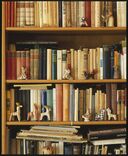
Bookcases in the Anna Seghers Museum
Akademie der Künste, Berlin © Photo: C. Zahn
After Anna Seghers’ death, her home and study were preserved as a Museum, today managed by the Akademie der Künste. Not only does the apartment still have all the original furnishings, but also Anna Seghers’ personal souvenirs from across the world including a collection of stones and sea snail shells, as well as pottery and musical instruments from Mexico. Her private library, comprising around 10,000 volumes, is especially impressive. The books, in shelves in all four rooms and the hallway, include volumes with dedications by authors from many countries who were her friends. A permanent display case exhibition shows photographs and documents illustrating the life of Anna Seghers and her family. The exhibition includes first editions of her books, such as Das siebte Kreuz which appeared in 1942 in the USA as The Seventh Cross and became a worldwide success. In addition, editions of German writers in exile published by the Querido Verlag in Amsterdam are also on show, together with Anna Seghers’ dissertation presented at Heidelberg University in 1924.
About Anna Seghers

Anna Seghers
© Courtesy of Anne Radvanyi
Anna Seghers was born as Netti Reiling on 19 November 1900 in Mainz. She studied philology, history, sinology and art history in Cologne and Heidelberg, where she presented her doctoral thesis. In 1925, then married to László Radványi, she moved to Berlin. Their two children Peter and Ruth were born in Germany’s capital city. Here, she also made her breakthrough as a writer with her short story Grubetsch (1927) and the novella Aufstand der Fischer von St. Barbara (1928 The Revolt of the Fishermen), which both won the Kleist Prize the year they were published. In 1933, Seghers and her family had to flee Germany to escape persecution by the Nazi regime. In May 1933, her books were among those burnt by the Nazis on Opernplatz in Berlin. The crucial phase of her life as a writer was shaped by her life in exile. In Paris she wrote her novel Das siebte Kreuz (1942, The Seventh Cross) and began with Transit (1944, Transit Visa). Leaving Paris on a dangerous and adventurous escape in spring 1941 to the unoccupied south of France, she fled on to reach Mexico. During the six years she lived there as an émigré she wrote the autobiographical story Der Ausflug der toten Mädchen (1946 The Excursion of the Dead Girls).
After returning to Germany in spring 1947, Anna Seghers was active in the Kulturbund zur demokratischen Erneuerung Deutschland, the Deutscher Schriftstellerverband (DSV), as well as the Deutsche Akademie der Künste, newly founded in 1950. From 1952 – 1978, she was also president of the DSV after it separated from the Kulturbund. On the international stage, the World Peace movement was a cause close to her heart. In 1950, through this commitment, she was one initiator of the Stockholm Appeal for an absolute ban on nuclear weapons. The new model of a society promised by the GDR seemed to fulfil the ideals of her youth, and allowed her to hope for greater social justice. In the 1960s, her advocacy of publishing Franz Kafka’s works in the GDR was indicative of her constant desire to support diversity in aesthetic and artistic views. On the occasion of her 75th birthday on 19 November 1975, she was made an honorary citizen of the city of Berlin, and in 1981 became an honorary citizen of Mainz, the town where she was born. Anna Seghers died on 1 June 1983 in Berlin. The most important awards she received during her lifetime include the Georg Büchner Prize, which she won in 1947, directly after her return from exile.
Anna Seghers left her artistic estate to the Akademie der Künste, where it is administered in the Anna Seghers Archive. She is buried on the Dorotheenstadt Cemetery in Berlin-Mitte.
International Significance
Aside from her nine major novels, including Das siebte Kreuz (1942, The Seventh Cross), Transit (1944, Transit Visa) and Die Toten bleiben jung (1949, The Dead Stay Young), Anna Seghers wrote over sixty novellas and stories, including the Karibische Geschichten cycle (1962, Caribbean Tales, previously individual novellas), Die Kraft der Schwachen (1965, The Power of the Weak), Sonderbare Begegnungen (1973, Strange Encounters) and Drei Frauen aus Haiti (1980, Three Women from Haiti). Her style was always sober and unsentimental, yet sometimes she left the realm of realistic narrative to include mythical and fanciful elements in her literary cosmos, as in her early work Die Legende von der Reue des Bischofs Jehan d’Aigremont von St. Anne in Rouen (1924/1925, The Legend of the Penitence of Bishop Jehan dÁigremont of St. Anne in Rouen, first published in 2003 from her personal papers), Die Toten auf der Insel Djal (1924, The Dead of the Island of Djal), Sagen von Artemis (1937/38, Legends about Artemis), and Das Argonautenschiff (1948/49, The Ship of the Argonauts). In her novella Die Reisebegegnung (1970), where she describes a fictional conversation between E.T.A. Hoffmann, Nikolai Gogol and Franz Kafka in a Prague coffee house, she shows programmatically – just as in her story Das wirkliche Blau (1967, The Real Blue) – that art and literature create their own reality where fantasy, dreams, and the unconscious also have their place – and hence she departs from the ideal of socialist realism propagated in the GDR. Anna Seghers always had a highly-developed sense for what was historically and socio-critically relevant – evident, for instance, in her Vaterlandsliebe speech (in Paris in 1935 at the International Congress for the Defence of Culture), Frauen und Kinder in der Emigration (c. 1938, first printed in 1985), her essay Glauben an Irdisches (1969, Faith in the Terrestrial) as well her writings on Tolstoy and Dostoevsky.
Bookcases in the Anna Seghers Museum
Akademie der Künste, Berlin © Photo: Andeas Süß
The reception of her works in West Germany was often hesitant; in East Germany, they often met with universal acclaim. In both cases, she was usually reduced, with the corresponding evaluation, to Das siebte Kreuz and an author following the official party line. In West and East Germany, it was much simpler not to have to look at the contradictions in Anna Seghers’ life and work. Yet such an approach did not do justice to her oeuvre’s complexity.
Today, Anna Seghers is regarded as one of the leading twentieth century German-language writers. Playwrights such as Heiner Müller or Volker Braun have adapted the themes of her stories for their own pieces, e.g., Müller’s inspiration for his play Der Auftrag (1979, The Mission) came from Seghers’ short story Das Licht auf dem Galgen (1961, The Light on the Gallows), while Volker Braun took Seghers’ novel as the basis for his Transit Europa (1988). Hans Werner Henze’s choral symphony Sinfonia N. 9 (1997) has a text by Hans-Ulrich Treichel inspired by Anna Seghers’ novel Das siebte Kreuz (The Seventh Cross). Anna Seghers’ works have been translated worldwide into 42 languages. Many of them have also been filmed.
The non-profit Anna-Seghers-Gesellschaft Berlin und Mainz has over 230 members from 14 countries, including renowned literary scholars from France, the USA and China. This literary society publishes the Argonautenschiff yearbook.
In accordance with Anna Seghers’ wishes, a Foundation was established so the royalties from her work could be used to support young writers through an annual Anna-Seghers-Preis. The prize is awarded to German-speaking or Latin-American authors on an alternating basis.
Since 2000, Aufbau Verlag Berlin, with editors Helen Fehervary and Bernhard Spies, has been publishing a critical, annotated edition of her works.