spreeklänge
A Musical Path Along the Spree
Curatorial Introduction
Julia Gerlach and Daniel Ott, curators of spreeklänge
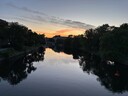
The River Spree is intriguing to us as a complex environment with a rich web of connotations, a place where historical, ecological, acoustic, social and global dimensions overlap and blend together. We commissioned 12 artists to create, within this heterogeneous setting, specific sound forms that connect to the site, are aesthetically coherent and, in addition, alter the way we hear and see our surroundings. Despite its modest size, the Spree – a slow-moving 400-kilometre-long river flowing through a water-rich glacial valley – was once a major trade route connecting East and West and later became a fluvial artery in a divided city replete with stories of people escaping across the border. The river, and consequently Berlin, is now threatened by “water stress” – a scarcity of water – caused on the one hand by the general climate crisis and, on the other, by shifts in industrial practices in its upper reaches, which could transform and even dry up large sections of the Spreewald, with its network of natural canals.
For the Musical Path, we chose a stretch of the river between two bridges in Berlin’s Charlottenburg district – Caprivibrücke and Rohrdammbrücke – a route with almost no road crossings that runs west along the south bank of the Spree through various urban zones. The path, which includes a wide variety of settings for the sound pieces, harks back to different developmental phases in Berlin’s evolution as a city while also gesturing towards the future through a number of major construction sites that are in the works. This section of the Spree features allotment gardens and renatured areas, which protect – or are designed to protect – the emergence of non-human living entities.
If you take a closer look at a section of the route and focus more intently on what you find there in the way of buildings – both ruins and those in use – trees and waterways, the historical and geological layers along the path can be peeled away, revealing a wealth of references, different levels to take in and a variety of aspects with which to engage.
Outside and on the Move
We were interested in the experience of being “outdoors”, of coming into contact with the weather, the air, whether cool and refreshing or warmed by the afternoon sun, and the special light that occurs in midsummer – the gradual transition, late in the evening, from day into night, civil twilight and nautical twilight – as well as the non-human creatures and living things that have their home along the Spree. And, of course, the soundscape as things grow quieter. We were also excited about the idea of walking as part of the process of engagement – both as physical movement per se and as a means of creating a perceptual environment that keeps yielding something new. We were not thinking about a static space, somewhere that could be controlled: the elements that make up these places are in a constant process of reconfiguration, just as the sounds, the music and the scenes within them unfold in ever-changing forms.
Leaving behind the concert hall, we go out into a public, open environment that facilitates unexpected encounters and interactions with art. For the artists invited to take part, this sharing of an urban space, this act of listening and tuning in, is a key focus, based on a relational view of the world.
Site-Specific
All the works are site-specific. The artists designed the sound pieces for a spot they chose themselves. The artistic form, the staging, the way the music is embedded in the existing acoustics and soundscape, and the contextual references within the works are closely connected to what was found in situ. “Site-specific” does not simply mean that the sounds are worked into the scene; the composers are also committed to a process of co-authorship that puts the environment and more-than-human beings on an equal footing as partners in the work of creation.
For example, the composition by Kate Milligan makes use of the particular acoustic situation that exists between the gardens and park at Charlottenburg Palace, the Jungfernheide railway bridge and the banks of the Spree: the result is a piece of music for four brass instruments that are stationed at some distance from one another. The surface of the water acts as a reflector that discreetly amplifies the sounds, while the musicians filter the ambient mix of sounds to define the pitches. Listeners can engage with this soundscape by walking through it with care – they will hear something different wherever they are, and in each spot, there is something new to discover.
Acoustic experiments of a very different kind are on offer, set up by school groups working in concert with the Selbstgebaute Musik team. Together, they have designed a map of Schlosspark Charlottenburg indicating special listening spots in the palace’s park and gardens. There are no acoustic additions here; the focus is on the tapestry of sounds and noises that already exist. In each case, the work of mixing and composing takes place in the listener’s mind – at best, mingled with imagined sounds heard within.
Stephan Froleyks’ performance also dovetails with the river’s special acoustic qualities and the vegetation found there. Seated in a rowing boat by the riverbank, he plays an instrument he has designed and built himself: the Saitenwanne, a kind of tub with strings. Making instruments from simple materials he has to hand is one of the hallmarks of the works produced by this composer and percussionist, who frequently applies an interdisciplinary approach, at times exploring the sounds made by water and developing suitable instruments. Here, the water’s acoustics support the sounds of the bowed strings.
Water, East and West, Day and Night
The Warsaw-Berlin glacial valley runs through here, created 18,000 years ago by retreating ice and meltwater. The sediments beneath the city vary between sand, mud and peat, and there are still oxbow lakes formed by old arms branching off from the river that are indicative of swampland. While the land needed to be drained to be reclaimed and developed, the River Spree has been the backbone of Berlin’s water supply for decades, with the metropolitan area’s drinking water sourced to date from the waterworks within the city. For a long time, there was even a surplus of water, which led, in the early 2000s, to the closure of the Jungfernheide waterworks on the Faule Spree arm of the river near Rohrdammbrücke. This created the conditions for a rich variety of brooding birds to prosper, including kingfishers and the rare little ringed plover. The area is also home to many species of bat, which circle above the Spree at dusk. However, with water scarcity threatening to manifest as soon as 2030 – caused by the green transitioning away from coal mining in Lusatia and the cessation of groundwater from the mines being pumped into the Spree, the emergence of major water-intensive industrial concerns such as the Tesla plant in Grünheide, and the AI boom – the Jungfernheide waterworks is expected to be put back into operation.
Peter Ablinger constantly pushed the envelope of what music can be, regularly reflecting on perception and offering new, very different takes on it. Noise was a main focus of interest for him, particularly “white noise” – as seen, for example, in the cycle of works weiss/weisslich. In Verspre(e)chungen, one of his last compositions, developed for the River Spree and the Maulwerker ensemble and rehearsed on site, a different kind of “noise” emerges in the continual “automatic speaking” of six protagonists. At this location, which Ablinger selected himself, the sound of the nearby lock can also be very faintly heard. The sounds of people verbalising “in the style of a (political) speech, a harangue, an announcement, or a piece of agitprop” is often related to the thematic environment of spreeklänge: the threat civilisation poses to the Spree and to the entire ecological balance.
Composer Annette Schmucki likewise works with language. For many years, she has been experimenting with the music of language and of speaking, exploring the variety of its shifting semantic possibilities. For example, she has created language-based compositions involving names of local landscape features and (forgotten) place names – translations of topography into music. For spreeklänge, she has focused on names from along the Spree in East and West, and her composition – which is in constant motion – is a reminder of the eventful history of East and West Berlin, which continues to this day in a dance of convergence and divergence, and even outright estrangement.
The shift from day into night allows us to see other creatures – particularly bats, which communicate using sonar. This is the starting point for Kristine Tjøgersen’s Liminal Beings, which takes place at Rohrdammbrücke towards the end of the route, near the Faule Spree, an old arm of the river. Tjøgersen’s compositions, whose themes often deal with nature and ecology, involve extensive research, including, in this case, a process of dialogue with bat researcher Mirjam Knörnschild at the Museum für Naturkunde, who supplied a wealth of audio material and shared her research and reflections. Yet Tjøgersen’s scenic composition does not set out to represent these creatures in terms that humans can hear; rather, it is an attempt – given the negative image they are credited with and the science-based view of them – to literally turn the relationship with them “on its head” applying a directorial stratagem that involves humour and a certain amount of exaggeration, creating its very own dynamic.
Forgetting and Remembering
In the 20th century, industry was drawn to waterways. Although not very wide, the Spree was an important commercial trade route between East and West, between Paris and Moscow. Large docks, now out of use, such as those at Westhafen, stand as a testament to their former heyday.
Earlier, nobles and guests of the royal couple (King Frederick I and Sophia Charlotte) would also embark from the Berlin Palace in the heart of the city and travel to Charlottenburg Palace to attend theatre performances, for example. As one of many industrial concerns, the burgeoning electronics company Siemens built its main plant north of the Spree in the late 19th century, together with an entire “town” for its employees – Siemensstadt – which had its own S-Bahn rail link. Although this line was destroyed in the war, its remnants can still be made out along the stretch of the river between the A100 and Rohrdammbrücke, along with a sign announcing the reactivation of the Siemensbahn railway. Behind the remains of the S-Bahn lies the Fürstenbrunner Graben, which carries water that was channelled off into the gardens at Charlottenburg Palace ahead of the lock and flows back into the Spree at this point. It derives its name from the Fürstenbrunn mineral water that was obtained here. The spring had been frequented by the Hohenzollern princes (Fürsten), which is how the mineral water that was drawn here got its name – until its proximity to a cemetery damaged its reputation.
Here, installed amongst the vegetation bordering the small ditch, the ELISION Ensemble’s double bassist plays and sings the freely notated composition by Liza Lim, which refers to Lethe and Mnemosyne, the rivers of forgetting and remembering. The composer is currently conducting a five-year project at the University of Sydney that poses fundamental questions about anthropocentric thinking and uses music to develop other forms of empathy and different ways of relating to the environment based on dialogue with First Nations scholars and artists. In the context of the spreeklänge project, this also involves spending time by the Spree and at the Fürstenbrunner Graben, tuning into the spirit of the place and what is there or is happening there – without undertaking any intentional action. Performed somewhat off the path, behind a screen of branches, the piece is an invitation to pause and listen in. The research project will be presented in detail at the conference Time to Listen: Multispecies Creativity in Music and Sound, scheduled on 26–27 June.
Just before this, you will have walked under Rudolf-Wissell-Brücke, the bridge carrying the A100 – Berlin’s six-lane urban motorway, a perennial source of controversy – which will soon need to be upgraded. An angling club has established itself beneath the bridge. On the island opposite stands a solitary industrial building, the only one remaining, which is now home to several floors of studios. It’s a non-place, one might say, and it is this contradiction that anchors Trond Reinholdtsen’s SPREE-UTOPIE, with its choir of 24 female voices (the Frauenchor der Künste) distributed between eight rowing boats. The piece takes as its starting point Zeus’s abduction of Europa, whom the god carries across the water to Crete, and ends with turbo-consumerism.
Local – Global
Water is one of the key global resources and is vital for drinking, irrigation in agriculture, cooling servers, industrial processes and urban development. It is also a major factor in global warming, playing a role in various climate disasters, caused, on the one hand, by torrential rain and flooding and, on the other, by droughts and desertification. The pollution of rivers and oceans by foreign substances or microplastics, as well as the interdependencies between CO2 and the climate, show that we are all connected at the global level and that local misdeeds can have an impact worldwide. This connection between global and local is reflected in various forms in a number of works featuring in spreeklänge.
Cathy van Eck’s performance takes place against the backdrop of local pollution of the Spree, which still prevents people from swimming in the city centre, and draws on the historical practice of washing clothes in the river and the semantic nuances hovering around the words clean and dirty. As is typical of her work in recent years, she uses new instruments that she has designed herself and combines acoustic and electronic sound elements in innovative and surprising ways, with loudspeakers, in particular, given an unusual role as instruments. The composer’s performative presence emphasises the local connection.
To broach the global context of the environmental and climate crisis right at the start of the Musical Path, we begin with one of the world’s most remote places, the island nation of the Philippines, where water is omnipresent and the impacts of global warming are felt immediately. Composer Susie Ibarra has already carried out numerous music projects focusing on water with communities in different regions of the world. Now, her artistic journey is taking her back to her home country, the Philippines. Her piece combines a sound installation – composed from audio recorded in a vast stalactite and stalagmite cave that has developed over millions of years and whose formations also register changes in the climate – with a performance that builds on a cultural practice of xylophone playing that has evolved over centuries. The rhythmic, percussive sounds of the saronay xylophones engage and play with the acoustics of the river, opening up the space, while the sound environment that emerges beneath the concrete bridge – which mimics the acoustics of a cave – is consolidated to create an intimate, concentrated listening setting, like a breath or a contraction.
The works of sound art created by biologist and artist Em'kal Eyongakpa have deep roots in the modes of thought and traditions of his homeland, Cameroon. The original title in the Kɛnyaŋ language and other terms he uses to describe his work refer directly to the region’s cosmology and mythology, such as the “veins of clockbirds” or the semantic variety of the word mbaŋ, which can mean “weather”, “flute” or “farmland”. His installations, with their focus on water, typically refer to the Manyu region in South-West Cameroon. Situated on the border with Nigeria, this is the region through which the River Cross flows before emptying into the Atlantic in the Gulf of Guinea. The connection to this distant place, to the water and to local ways of thinking is not simulated through sound recordings but through the real-time generation of sound structures from the geophony and biophony of the Spree. This comes out of Em'kal Eyongakpa’s interaction with the river: sitting aboard a pedal boat that has been specially prepared with water drums and hydrophones, he collects sounds and transmits them in the form of a mechanical vibration to a platform, a “drum island”, where the sound structures, layered on top of one another, can be physically felt by the audience.
The Musical Path finishes on the far side of Rohrdammbrücke with a large-scale sound piece by two Bolivian artists, Carlos Gutierrez and Tatjana Lopez, a participatory and transcultural project involving school groups and students from Berlin, as well as a Berlin-based group with Andean roots. Gutierrez and Lopez have devoted years to researching the sounds of the Altiplano, the Andean highlands of Bolivia. Taking their cue from a pre-Hispanic musical tradition transmitted orally, they invested themselves in various instruments with microtonal capabilities: produced from clay or other natural materials, these instruments have no connection to the tempered tonal system of the West.
Specially made for the project on the basis of a traditional technology and water mythology dating back 1,000 years, the ceramic instruments and masks, as well as the creation of music in harmony with the environment, rely on the idea of listening in and co-creating.
We are grateful to all the artists who have engaged with this provocative project and developed such unusual pieces. We would also like to thank our sponsors, the Capital Cultural Fund and the Gesellschaft der Freunde der Akademie der Künste (Society of Friends), for their faith in this project, as well as the many patrons and partners who supported the development of particular works.