12 Sound Situations
1. Susie Ibarra
Singing Boat at Biak Na Bato Caves (2026)
A Philippine Tropical Cave System and National Park in Luzon, Philippines
with
Susie Ibarra, Jake Landau, Bilawa Respati (Sarunay / Philippine xylophone)
Jake Landau (sound design, installation)
Malte Giesen (Studio for Electroacoustic Music at the Akademie der Künste)
The installation is based on field recordings that Susie Ibarra made on-site together with Jake Landau, with the support of lead Paleo climate scientist Dr. Daniel Ibarra and the cave monitoring team at the national park in the Philippines.
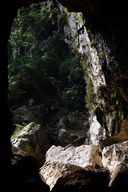
Water and climate form a nexus that links places together, even when they are very far apart. This connection between the local and the global is an important element in Susie Ibarra’s Singing Boat at Biak Na Bato Caves, which consists of the sound installation Biak Na Bato and the live performance Bangkang Umaawit. Emanating from beneath Charlottenburg’s Caprivibrücke, whose reinforced concrete structure dates from the 1950s, recordings can be heard from the stalactite and stalagmite caves of the Biak-Na-Bato National Park in the province of Bulacan in the north of the Philippines: dripping and flowing water, accompanied by Ibarra’s performance playing on the stalactites of the Columbus Cave located there. She delicately taps out a beat on them using drumsticks and her knuckles to activate their resonant responses, which she records with contact microphones.
In the tropical cave’s virtual acoustic space, floating beneath the road bridge crossing the River Spree, the live performance of Bangkang Umaawit can also be heard; translated word-for-word from the Philippine language Tagalog, the title means “singing boat”. In a canoe on the Spree, composer and percussionist Ibarra – together with Jake Landau and Bilawa Respati – performs her composition for three sarunay xylophones: simple metallophones with eight sound plates, each with a boss in the centre, held in place by strings and braced across a frame.
While the instrument originally comes from the Maguindanao culture of the southern Philippines – where it was used as a classroom instrument for training students in the art of the bossed gong that features in the kulintang ensembles – it has now gained currency, along with kulintang playing as a whole, in many parts of the country.
Ibarra grew up near Houston as part of an immigrant Filipino family. Her composition Singing Boat at Biak Na Bato Caves addresses experiential spaces made accessible through the ear. Visitors are invited to feel into these spaces and connect with the specific locations, ecosystems and the history that informs them. The material she has composed goes beyond the sounds emerging from the caves of Biak-Na-Bato National Park and the playing of the sarunay to bring in a varied frame of reference. This points to the performance practice and musical culture of the sarunay and kulintang ensembles in the Philippines.
An ancient myth telling of their origin says that once upon a time, a princess fetched a series of stones from a river and began to play on them. The sound of these stones was so beautiful that people sought to mimic it – and ultimately managed to reproduce it with bossed gongs and metal plates that could be played. It also alludes to the caves of the Biak-Na-Bato National Park, with their unique flora and fauna, and provides information on the processes of ecological and climatic change recorded by the stalactites and stalagmites, which have developed over millennia and now offer themselves to be read.
A further upshot of this, however, is that Ibarra’s own approach to engaging with the sounds of nature can be understood and actively experienced. As a composer and percussionist, she works – as she describes in her book An Ecology of Rhythm – with natural sounds such as birdsong, the ocean, the water of melting glaciers, insects and the forest, exploring their internal structure from a posture of listening and entering into a creative dialogue with them.
2. Annette Schmucki
ostspree-westspree
river island border bridge (2026)
with Christian Kesten (voice, performance)
On the riverside path between the two bridges, Caprivibrücke and Schlossbrücke, Christian Kesten moves to and fro amongst the audience. The performer carries out a strict ritual: a cassette recorder is connected to a long cord; following a choreography whose seven sections are repeated in a loop, he sometimes walks away from the device, unspooling the cord as he goes, and sometimes tows it behind him on a leash that may be short or long or pulls it towards him, as he coils the cord up again. He does this in different directions, sometimes going one way, sometimes the other. Swiss composer Annette Schmucki conceives of language as music, and her score, which is more than just a simple series of instructions and also constitutes a literary work of art, contains the following:
it is about the river. with the flow, against the flow.
and it is about a border (divan/douane/room at a checkpoint with many cushions, where tea
is drunk and traded). about getting across the border.
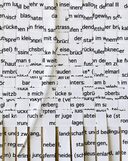
The two sides of the cassette contain voice recordings of a series of names, whose sequencing follows the course of the River Spree: bridges, islands, places, outfalls and abandoned arms of the river. Side A begins with Marschallbrücke, the bridge connecting Wilhelmstraße and Luisenstraße in Mitte, located to the east of the Reichstag and the section of the Berlin Wall in the heart of the metropolis; it then continues eastwards to Dämeritzsee, a lake on the edge of the city through which the border between Berlin and Brandenburg runs. Side B begins with Kronprinzenbrücke, the bridge west of where the wall once stood, and follows the Spree to its confluence with the Havel.
the piece has no beginning and no end. it is a great loop that seems to go on forever.
it is about walking, about taking countless steps, enumerating an interminable list. names are named. names of bridges, islands, sediment.
the river is probed and explored, its geology, its landscape, its architecture.
there is discussion, commentary, breathing, buzzing, and melismatic singing.
from silent to very loud.
If the performer moves downstream, heading west, sounds of the place names of the “East” Spree are heard. When he goes upstream, we hear those of the “West” Spree.
the piece is a duet that transcends borders. the sounds that come from the cassette recorder are “ulterior”, beyond the limits of what is spoken, sung or danced live. it is a tempo created by the names of meadows, plants and bridges, and the configuration of the ground in the river landscape, a tempo that articulates and gives rhythm to what happens this side of the line: walking, speaking/singing, other actions. it is an audio score.
the words spoken, their sound and rhythm, generate cues for the protagonist’s actions to begin, determining their duration and pulse.
The place names also constitute the raw material for the performer’s vocal part. They are broken down into individual syllables and sounds and recomposed as tonal material using a strict formal approach, acting as the scaffolding for the score on which the seven sections are based. However, set into this score are dances and interludes, songs and refrains, associative texts about striding, rambling and walking, as well as collages of technical geographical terms:
at the same time, the cassette can be stopped (pauses, refrains, veerings-off) or even recorded over (rec) with new words or names, with articulations of things found at that moment in the vicinity.
the content of the cassette is thus re-recorded during the performance. landscape is laid down on top of landscape. names overwrite names.
each performance allows the score, and thus the piece itself, to be compressed, changed or simply to vanish.
In configuring the individual sequences, the performer is free, to a degree, to make modifications within each pass and to ensconce himself on the “divan” or on his picnic blanket with a cup of tea. Or, as Schmucki writes:
overall, the piece contains a wealth of possibilities, and the protagonist chooses in the moment how he will continue. In other words, no one hears the whole “piece”. it is always just an excerpt from a perpetual to and fro.
3.Sound Map
How does the Spree sound like?
Sound Map for the audience
with and by Selbstgebaute Musik (Luise Wilhelm / Hajo Toppius / Sascha Schneider / Karlotta Fries), the advanced and basic music courses at the Heinz-Berggruen-Gymnasiums Berlin, classes 3c and 5d at the Schinkel Grundschule Berlin and visitors to Schlosspark Charlottenburg (Charlottenburg Palace Gardens)
How do the gardens and park at Charlottenburg Palace sound? What sounds can be discovered there? What did it sound like in the past, and what can still be heard from back then? What role does water play in all this – in the park with its different ponds and streams and through the sounds mediated by the River Spree, which runs right next to it? Visitors to spreeklänge are invited to consider these questions and actively participate, seeking out “sound spots” by listening intently, discovering sounds in their surroundings, and tapping into the soundscape – both past and present.
Participants will be handed a sound map for the purpose, listing different listening spots, as well as instructions on how to listen – based on the idea that listening and hearing ambient sound is the stepping stone to active perception, a conscious alignment of the senses, a focusing of the attention and a concentration on specific sounds.
The sound map was developed by Selbstgebaute Musik over the course of numerous workshops and recces, together with school groups of varying ages and from different years, ranging from a Year 3 class at the Schinkel Grundschule primary school to the advanced music course at the Heinz-Berggruen-Gymnasium secondary school. They explored the gardens and park with their ears, focusing on what sounds can be heard in different parts of it today – and how it may have sounded at various times in the past.
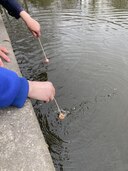
They also worked with diverse resources to help them hear and create sounds, enabling them not only to explore the landscape acoustically but also to “play” it and engage in a musical dialogue with it. Straight or curved sound tubes were made from plumbing pipes or cardboard; various objects for generating sound were put in water and played; and drumsticks and items that can stimulate sound were produced from a variety of materials, including wood, metal and rubber.
These could be used to play on signs and bins, park benches, trees, metal fences and particular sections of the route – as a way of finding sounds and creating an acoustic topography of the gardens and park.
4. Kate Milligan
Rivurtext (2026)
Site-specific installation for flute, trumpet, trombone and horn
with ELISION: Paula Rae (flute), Tristram Williams (trumpet), Ben Marks (trombone), Deepa Goonetilleke (horn)
The river’s soundscapes, which Australian composer and designer Kate Milligan conceives of as a corridor through a landscape – in this case, an urban space – are an integral element in the work. The water flows downstream, with the ecosystem it supports also in flux. At the same time, the River Spree also forms a corridor through the city for the flora and fauna that live above the water. Along its banks, the audience moves through an acoustic event that is likewise in constant motion.
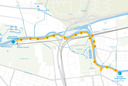
It is less than a kilometre from Charlottenburg’s Schlossbrücke to the S-Bahn bridge at Jungfernheide station; four musicians from the ELISION ensemble – flute, trumpet, trombone and horn – are positioned along this stretch of the Spree, far enough apart that the instrumental sounds produced by their neighbours mingle with the sounds of the riverine landscape to such a degree that the music is all but imperceptible or blends into a complex overall sound. Milligan writes:
“The four instrumentalists are dispersed at significant distances along the riverbank, which means the swirling complexities in the environment mediate their ensemble communication. The delay in the production and reception of sound (and its transformation in the meantime) is at the core of this work: rhythm and sequence are perceptual phenomena, always relative to the churning geography of the River. The audience participates in the music’s emergence as they walk, changing their configuration within the River’s sound system.”
Milligan has not specified any pitch levels for the four musicians; instead, she has notated volume progressions within specific time periods – simple structures consisting of crescendos and decrescendos – and the sequences in which the individual instruments respond to one another. The precise pitches are to be ascertained at the site of the performance and in concert with it. With this in mind, she gives the following instructions:
“Picking a fundamental pitch that resonates with the room/River landscape and using this as the baseline pitch material for the work. The pitches will need to be chosen in situ during rehearsal – factors affecting choice include the clarity of what can be heard across distance at various dynamics. This is an unknown factor in advance.”
This audio material can and should be developed in situ, working with the overtones that build on the basic tone, with the rhythmic and dynamic variations within the specified system of sound transfer and reciprocal response, and playing with durations and acoustic periods. In every case, this takes place in dialogue with the site and the other players involved in a piece, whose focus thus falls on processes of perception and communication:
“This work belongs to a lineage of outdoor composition which seeks to explore the nuances of communication over distance, and the way messages are co-constituted by the richly agentic environment – in this case, meaning is co-created with the River. Conceived for flute, trumpet, trombone, and horn, the work makes reference to historical signalling instruments, often employed in military contexts as forms of mediated power and control. In Rivurtext, these imperial connotations are gently undone by the River’s steady flow, and the relinquishing of the instruments’ sound to environmental relativity.”
In Rivurtext, Milligan challenges traditional ideas of authorship. She consciously eschews any notion of herself as the sole composer of the piece; instead, the inclusion of “site-specific” in the work’s subtitle implies that this location is not a mute container that absorbs a composer’s artistic visions but rather a co-creative artistic partner.
The composition was created as part of the University of Sydney / Sydney Conservatorium of Music’s research project “Multispecies Creativity and Climate Communication” (2025–29), funded by the Australian Government.
5. Peter Ablinger
Verspre(e)chungen (2026)
for 6 speakers
with Maulwerker (Ariane Jessulat, Henrik Kairies, Katarina Rasinski, Tilmann Walzer, Steffi Weismann) und Fernanda Farah
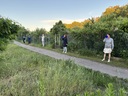
The composition Versprechungen, or rather Verspre(e)chungen – as it is titled for its world premiere as part of the spreeklänge festival, suggesting promises centred on the River Spree – is one of the last works by Austrian composer and sound artist Peter Ablinger, who died in April 2025. The piece was created for the Maulwerker ensemble, with whom Ablinger worked before his death. Like many of his compositions, it is recorded in the form of a verbal concept, in which Ablinger writes:
#
Vocal sculpture for 6 speakers (a mix of male and female voices), spread out in a well-spaced line, with a mobile audience
#
Duration: variable, semi-permanent
#
A piece designed for outdoors; perhaps also for unusually long spaces (corridors) or vast halls – but not, under any circumstances, for a regular concert set-up with a seated audience
#
Positioning, outdoor variant of Verspre(e)chungen, as part of spreeklänge 2026: the trail is the place – the public walks along it or stops for a while at individual stations. Verspre(e)chungen is one of several such stations. Deployment of the six speakers beside the path / on the banks of the Spree, looking out over the river; poss. also on one of the Spree bridges – if the trail leads across one.
#
Everyone speaks all the time – or rather, whenever there is an audience within earshot. Everyone speaks simultaneously and largely independently of one another in six parallel monologues, in the style of a (political) speech, a harangue, an announcement or a piece of agitprop.
#
There is a close relationship between the distances separating the speakers and the volume at which they speak: each speaker should be able to follow well enough what their immediate neighbours are saying – even while they are speaking themselves. This means that they must speak loudly – as if the idea was (in the case of the Verspre(e)chungen) for their words to reach the other bank of the river. Ideally, the minimum distance between the speakers should be 5 metres, so that a full line of 6 speakers would extend 25 metres. However, a greater distance – e.g., 7–10 metres, with a line extending 35–50 metres – would expand the experiential space for listeners and walkers and accentuate the difference between their engagement with individual speech acts and their gradual exploration of these acts in their entirety. However, the primary criterion for deciding the distance is to ensure that neighbouring speakers are sufficiently audible. (“Sufficiently audible” does not always just mean “intelligible”. Things can also be misunderstood.)
#
The text is an impromptu improvisation – or rather, six parallel improvisations – based on “automatic speaking”. Automatic speaking is the essential, overarching level into which two other levels are integrated.
The three levels of verbal improvisation:
1
Automatic speaking
2
Listening/responding to one another (“Chinese whispers”)
3
Topic-based (“Stickers”)
and the Spree version
The three levels of verbal improvisation correspond to the three developmental steps involved in making the piece. The basis, as practised in the first phase, is automatic speaking, both individually and in a group: a mode of speaking that “seems fairly consistent in terms of syntax”, although it actually involves sentences that are devoid of any meaning or intention, a stream of words determined by free association and chance. The second phase focuses on inserting, via individual words and terms, moments of interaction and reciprocal response within this continuum of speech.
The third phase, which is also “grafted – affixed, as it were – onto the previously established Level 1 (automatic speaking)”, involves the addition of the “stickers” level. The choice of words spoken here is restricted to a particular topic, which, as a “label”, creates meaning within the stream of mindless talk. When Verspre(e)chungen is performed as part of spreeklänge, the topics are “the water regime, water policy and, more specifically, the ecology of the Spree and its waters and associated themes.”
6. Stephan Froleyks
two hands, two bows (one man in a boat) (1987/2026)
with Stephan Froleyks (Saitenwanne)
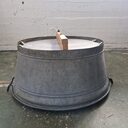
Half-hidden amongst the vegetation, a man sits in a rowing boat moored on the bank of the River Spree, while the S-Bahn trains thunder past nearby – two states of normality that interact with one another. Seated under a fishing umbrella, Stephan Froleyks plays the Saitenwanne. This is one of the self-made instruments he developed in the 1980s, building on his long-standing artistic and educational work with “scrap-metal instruments” – along with the “knife table”, the “flute machine” and the “curved tuba”. The Saitenwanne is a zinc tub with two guitar strings stretched across a wooden bridge – Froleyks plays it using two violin bows.
In his role as a composer-performer, Froleyks, who was born in Cleves, has used his homemade instruments over the years to develop sketches crystallised through improvisation, which in turn form the basis for complex compositional structures. He writes:
“Over time, these sketches take on independent form as larger musical compositions with a precisely defined structure. When they are performed live, this groundwork is reduced to its essence: the instrument, musical awareness and physicality generate highly individual results produced in ‘real time’ with an appreciation of the risks involved.”
In the new version of two hands, two bows (one man in a boat), Froleyks specifically references the Spree performance. As an “angler” in his boat, he blends naturally into the scenery. And as a player of the Saitenwanne, he goes on an “excursion into the mountainous world of overtones”. Using the violin bows, he plays overlapping tremolos on the instrument, creating, “through countless thousands of rapid and lightning-quick back-and-forth movements, clusters of high intensity sound”: scintillating, vibrating spectral sounds that stand in tonal analogy to the refracted light on the waves of the water.
Froleyks describes the acoustic impression as a fluidly light “gliding over water”, which develops from the mise en scène of his performance as a subtle, ephemeral intervention. Here, the casual nature of this intervention stands in contrast to the composer’s requisite commitment as player of the instrument he designed himself. This is “physically demanding and not altogether easy to play.”
7. Trond Reinholdtsen
SPREE-UTOPIE (2026)
with Frauenchor der Künste (Azadeh Azimi, Monia Bab, Agnes Banniza, Lisa Baurmann, Paraskeva Dumler, Nicolette Edel, Magdalena Eichhorn, Hannah Endrulat, Philine Hartleb, Antonina Jach, Mamiko Kan, Ella Kastner, Karina Kemere, Anna Kirchhoff, Dana Krehl, Maria Krüger-Bischof, Enna Lukow, Antonia Meissner, Cosima Metzger, Debora Ohser, Olivia Palmer-Baker, Juliane Syrjakov, Sally Uhlemann, Maren Weissmann, Siyi Xia)
Directed by Maike Buhle
Existential power, sounds and images charged with symbolism are the elements Norwegian composer Trond Reinholdtsen uses to construct his combinations of music and theatre. In them, he gets material with discursive power informed by myth, text and theory to collide, collapse and collaborate beyond any putative commensurability, synthesising it into a critical mass of art experiences that dazzle the senses. In the foreword to SPREE-UTOPIE, he writes:
While Europa and her maidens were picking flowers, she spied the bull (Zeus in disguise), stroked his flanks and eventually climbed upon his back.
Seizing the opportunity, Zeus ran to the sea and swam with her on his back to the island of Crete.
Europa = Europe. Zeus / The bull = capitalism? Crete = USA??
Europa/Europe – may relate to Erebus (darkness) (no, that’s a bogus etymological connection).
The Greek word Εὐρώπη (Eurṓpē) may have been formed as a combination of εὐρύς (eurus), well … “wide, broad” and ὤψ/ὠπ-/ὀπτ- (ōps/ōp-/opt-): “eye, face, countenance”.
Attempts have been made to associate Eurṓpē with a Semitic term for “west” – either with the Akkadian “erebu”, which means “to go down, to sink” (in reference to the sun), or with the Phoenician “ereb”: “evening, west”. (probably not correct …)
Europa/Europe = sunset. The demise of the West. Etc.
SPREE-UTOPIE features the 24 singers/performers of the women’s choir at the Berlin University of the Arts. Divided up into groups of three, they occupy eight boats moving along the Spree beneath Rudolf-Wissell-Brücke, a bridge on Berlin’s urban motorway: a place where the river’s natural environment meets modernity – turned into a concrete mass – with its uncompromising exploitation of the world in value chains, accompanied by the requisite transport infrastructure.
Zeus / John Cage stole Europa / the history of Western music and allowed it to return to anarchy, relativism, neoliberalism, turbo-consumerism, techno-feudalism and chaos. And now here we stand on the brink of fascism.
The 24 singers are dressed, like ghosts, in white robes; in addition to a copy of the score, they each have with them – taped to their bodies – a tuning fork, the mouthpiece of an English flute (recorder), and kitchen items such as cups, kettlesor metal sponges, to be used as percussion instruments. Reinholdtsen has composed a separate “songbook” for the individual trios, with 32 short sections: small three-part movements, and action and percussion scores. These are performed – with only loose synchrony between the eight groups/boats – densifying over the course of the piece to produce a shared climax:
Is it possible to put some of the parts back together?
Collectivity, rationality, beauty, courage.
Universality! We need a MIRACLE! A MAGICAL TUTTI EVENT!
Our enemies: echo chambers. False, obscurantist groupings. The internet in general.
The piece is an attempt (in the form of a game?) to achieve a MAGICAL TUTTI EVENT.
8. Liza Lim
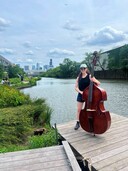
[K{not]w}, The Knot of now and not knowing (2026)
for a double bassist / also singing
with ELISION, Kathryn Schulmeister (Kontrabass/Stimme)
“A central thread running through several of my projects is animism explored as a counter to the notion of nature as a mute, extractable resource. The animistic worldview is one in which meaning and relationship are available as a correspondence between more-than-human forces and those who listen, a conversation carried by attention and encounter.”
In her notes on [K{not]w}, The Knot of now and not knowing, Australian composer and researcher Liza Lim describes how a practice of active yet attentive listening can form the basis for “re‑awakening of capacities for listening, co-becoming, communing and expressing with the visible and invisible beings that inhabit the living world”.
However, this kind of listening – which goes beyond an anthropocentric view of the world informed by Western rationality – can only provide access to a deeper understanding of our natural environment if it disengages from a strict duality of a subject that perceives and understands and an object that is perceived and understood. It conceives of itself as a dialogue that is actively conducted by both parties.
Within such a dialogue, the dialectic of forgetting and remembering, of dissembling and disclosing, plays an important role – for Lim, the ancient Greek myth of Lethe and Mnemosyne, the rivers of forgetting and remembering, is a key point of reference here: in the myth, one cannot be conceptualised without the other, and it is only the interplay of oblivion/concealment (λήθη) and exposure/revelation (ἀλήθεια) that allows the rivers to flow in the first place.
In this sense, Lim does not regard her composition – which was written for double bassist Kathryn Schulmeister – as a piece in which its interpreter, to whom it is dedicated, treats the bass as an object she can play and use. Lim focuses, rather, on the idea that “performers and musical instruments can merge into hybrid creature–human entities; the moments in which the human is, in a sense, consumed by their instrument.”, by entering into a dialectic of reciprocal losing and finding, of forgetting oneself and remembering.
This idea has found its way into the musical facture of [K{not]w}, The Knot of now and not knowing and figures too in Schulmeister’s staging at the performance site, as she stands with her bass, right “in the flow”, as it were, on a footbridge over the Fürstenbrunner Graben – a small stream that flows into the Spree – and thus finds herself, symbolically, both in and above an imaginary “River Lethe”. There she plays short flourishes on the instrument, eliciting sounds that she then sings into.
Bass and vocal come together in unison, becoming lost in one another, merging and moving apart. Playing with and in the flow becomes a symbolic act, bringing out a key question that Lim has on the subject of representation and performance: “Can we disappear and reappear in the flow of our attention and intimate noticing? What nuances signal to us and call us into relation? What might be ours to tend to…and what remains outside the scope of our knowing?”
The composition was created as part of the University of Sydney / Sydney Conservatorium of Music’s research project “Multispecies Creativity and Climate Communication” (2025–29), funded by the Australian Government.
This program of research is funded by the Australian Government through the ARC Laureate Fellowship: Multispecies Creativity and Climate Communication. The views expressed herein are those of the authors and are not necessarily those of the Australian Government or the ARC
9. Em'kal Eyongakpa
Bɛfap baka iv rt/barɔŋ bɛtandat (mbaŋ)
with Em'kal Eyongakpa (performance)
Dustin Zorn (Studio for Electroacoustic Music at the Akademie der Künste)
The titles of the works by sound artist Em'kal Eyongakpa have a specific meaning. He uses them to organise the works into distinct groups defined by the methods applied and the techniques and materials involved. Accordingly, his artistic practice also draws on the modes of thought and traditions that have fed into it.
The titles are in Kɛnyaŋ, a language spoken in the south-western region of Eyongakpa’s native Cameroon, primarily in the province of Manyu on the border with Nigeria. The region is traversed by the Cross River, which empties into the Atlantic in the Bight of Bonny in the Gulf of Guinea – these two natural environments, the river and the bight, are also cultural spaces and constitute a repeated frame of reference in Eyongakpa’s works.
Bɛfap baka iv rt/barɔŋ bɛtandat (mbaŋ) is part of a larger complex of “reflections”, as Eyongakpa terms the different groupings within his artistic practice; this complex is titled mbaŋ, which can be loosely translated from Kɛnyaŋ as “weather”, “flute” or “farmland”. The “reflections” in this group link to the artist’s sound-based installations sǒ batu and Tángáp, which he began developing further in 2020; these works often emerged, in turn, from the self-organised research/laboratory spaces of the Bɔ Bɛtɔk project.
Enacted outdoors, they explore questions relating to liminal spaces and portals, and our connection to the world and to community-sustaining practices rooted in this connectedness. They generally relate to the theme of “water” and often have concrete links to specific places such as the Gulf of Guinea. The works that form part of sǒ batu and Tángáp are multi-channel sound installations with pre-recorded sound material that Eyongakpa elaborates with polyrhythmic structures. By contrast, the soundscapes in the mbaŋ projects emerge, as Eyongakpa writes, “in real time from the geophony and biophony around the installation sites, while interacting with analogue instruments that are dependent mainly on weather elements.”
In Bɛfap baka iv rt/barɔŋ bɛtandat (mbaŋ), the instrument and interface for generating and transmitting the sound is a pedal boat that has been specially prepared for the purpose. The boat serves both as the vehicle for Eyongakpa’s procession on the River Spree, blending into the riverine landscape as an ephemeral event, and as a polyrhythmic percussion instrument that “plays” the river as if it were a water drum. Audio signals are “collected” from the boat and transformed electroacoustically to be further processed via Eyongakpa’s e-mungo west / ekoi east #7 interface, which works with data such as water flow rate and atmospheric pressure. However, the musical structures also relate to the “veins of clockbirds” and the mythology of the ekoi-Ejagham pantheon from South-West Cameroon and South-East Nigeria.
These soundscapes can be listened to on an ɛfap baku, an island of drums – the Bɛfap baka in the title is the plural of ɛfap baku. This is a serpentine platform located on the riverbank, to which the audio signal from the pedal boat is transmitted via transducers. The signal is converted into a mechanical vibration below the audible range, which the audience perceives as pulsations that can be felt physically as they sit or recline on the platform looking out over the Spree.
10. Cathy van Eck
30 Grad
with Cathy van Eck (Performance, Elektronik)
The fact that we need water for washing is as universal as it is obvious. And it begs certain questions. What does it mean to talk about “clean” and “dirty” – both from an ecological and from a laundering perspective? When we talk about “clean water” in the context of a river’s ecosystem, we imply, among other things, that the water contains suspended matter and microorganisms in a natural balance.
This, however, is not meant to be the same water we use to wash our clothes. Instead, a whole range of chemicals are added to clean the laundry, some of which are major contributors to water contamination. These chemicals should, where possible, be removed again before the “waste water” is channelled back into nature.
Berliners traditionally used water from the Spree for their washing needs; today, around 70% of the drinking water used for washing is derived from bank filtration. Yet, right along the Spree, industrialisation prompted the establishment of large factories that could exploit the river as a transport route and use its water for all kinds of purposes, for cooling, for example, or for producing steam. This also occurred on the north bank of the Spree between Charlottenburg and Spandau, where, around 1900, Berlin witnessed the construction of one of the city’s largest industrial areas – only part of which is still in use – together with the neighbouring Siemensstadt district.
Today, the Bosch-Siemens-Hausgeräte GmbH’s Technologiezentrum für Wäschepflege (Technology Centre for Laundry Care) is located there, directly opposite the spreeklänge event. According to the corporate brochure, this is where “efficient and sustainable laundry care appliances for the global market” are developed and tested to determine, among other things, energy and water consumption and detergent usage, and detect microplastics washed out of the clothing – and to gauge the sound produced, for which there is a separate acoustics laboratory.
Belgian-Dutch composer and sound artist Cathy van Eck, who teaches in Switzerland, refers to this in 30 Grad. She turns washing – which has now become an almost intimate process carried out mostly in private – into the material of her performance presented with a theatrical, symbolic flair, and links it to a sound event as a musical facet of the work. It addresses the relationship between “clean” and “dirty”, the cycles of water and what is washed. In this way, she puts the focus on what we wear, which, on a material level, engages in a process of exchange with the water in every wash cycle, not only when substances clinging to our clothes are rinsed out and removed, but also when particles are washed out and flushed away. From this perspective, clothing itself is in a constant state of flux, governed by fashion, personal preferences, use and consumption, wear and tear, and disintegration.
11. Kristine Tjøgersen
Liminal Beings
with Colin Eccleston (visual team), Ellen Jerstad (visual team/performer), Karin Hellqvist (violin), Jennifer Torrence (percussion), Lars A. Skoglund (performer)
In Liminal Beings, Norwegian composer and clarinettist Kristine Tjøgersen turns Rohrdammbrücke into a stage for an immersive piece of musical theatre in which art and nature, found and staged material, are woven together and related to one another in a perfectly structured composition.
This gives rise to a play of transitions and surprises poised on the threshold, brushing against and crossing boundaries, and making the liminal the subject of the compositional work in multiple respects.
The focus here is on “liminal beings”, on bats and mythological figures patrolling the borders, on how the world is perceived and on how this perception causes boundaries to shift and be shifted. The work also examines the lines separating the different genres of art and their distinctive forms of expression: thus, while musical theatre is regarded, classically speaking, as an intermedial work of art, the fundamental split between the senses of sight, hearing and touch – between sound, image and scene – is constitutive of the genre, whose structure is based on the way the human sense organs are configured.
This is radically challenged, however, by the manner in which bats perceive the world. These nocturnal animals “see with their ears”, while their eyes are virtually blind. Bats have a highly tuned, sonar-based sense of spatial orientation – in other words, they use acoustic signals in a range that lies at and beyond the limits of human hearing. However, they also communicate with each other in this frequency range by “singing” – using sounds and noises much as humans do. Back when bats’ reliance on echolocation was still uncharted territory, they were regarded as creatures from another world – as animals of the night, denizens of an unknown, uncanny realm, a world inhabited by ghosts and the spirits of the dead.
Crossing the threshold that leads there is a step into a realm that is essentially unknown, but it may also have one or two surprises in store. What is certain, though, is that this change of location is accompanied by a shift in the world and in our way of perceiving it. As Greek mythology knew only too well, when you are on your way somewhere, what matters is that you don’t turn around.
Ultimately, though, Liminal Beings is also a piece about the line separating art and nature, real and replica, reproduction and representation. It is about making audible what is inaudible, making palpable what people sense but ostensibly cannot grasp, and creating spaces for experience in which the ways we perceive the world can be handled in a playful manner that is full of surprises.
New composition funded by the Norwegian Arts Council; travel grant: Music Norway
A collaboration with the Museum für Naturkunde, Prof. Mirjam Knörnschild
12. Carlos Gutiérrez / Tatiana López
CHRRR XH’IXI Q’PJJ
with
- Carlos Gutiérrez (composition, artistic direction)
- Tatiana López (ceramic objects, visuals, performance)
- Phusiris de los Andes, Berlin (Camilo Agramont, Eduardo Blanco, Sebastian Hachmeyer, Javier Lazo,
- Paola Machicado, Cecilia Núñez Jesika Paredes, Lesly Quiruchi, Jharka Salvador, Froilan Urzugasti)
- Secondary-school students from the Heinz-Berggruen-Gymnasium Berlin (advanced and basic music courses , teacher: Anna Stark, kiln: Till Kreische)
- Students from Berlin University of the Arts and Freie Universität Berlin (Niki Arde, Laura Bellusci, Johann Bicher, Mariella Castelo, Anne Eding, Nicolas Ernst, Børge Furnes, Bronka Palesova, Davi Raubach Tuchtenhagen, Miquel Barja Romero, Benjamin Welten, Seonbhin Woo)
Coordination and workshop support: Selbstgebaute Musik (Lara Mikosch, Hajo Toppius)
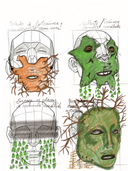
To the west of Rohrdammbrücke, the banks of the River Spree stretching past this bridge have been shaped by industrial activity, much of it now a thing of the past. Nature is reclaiming the wasteland that industry left behind, giving this landscape its own rather distinct character. In CHRRR XH’IXI Q’PJJ by the Bolivian-based duo Carlos Gutiérrez and Tatiana López, it becomes the site of a “localised ritual” and a space for artistic practice that understands the performance not as the presentation of a work developed for this purpose but rather as part of a process in which objects and the bodies of those involved “co-resonate” with the landscape – or, as López and Gutiérrez describe it:
“The work is based on a fundamental decolonial premise and an Andean view of the world, in which sound is conceived of not just as an acoustic phenomenon but as a living force. Seen from this perspective, artistic practice shifts away from representation toward embodiment: those taking part momentarily become vehicles for hybrid sound entities – both animal and vegetable, a mix of insect, bird and plant – thereby breaking open modernity’s ontological distinctions and allowing an expanded ecology of the sensory to be articulated.”
In principle, Gutiérrez and López see their work as artists as participatory and process-oriented: they collaborate with the participants on creating the instruments that will be used and on developing the musical material for the performance with the help of these instruments, which are played and experimented with in a “practice of listening and embodiment”. The third step involves relating the outcome of this process to the landscape of the performance site.
López employs her talents as a visual artist while building the instruments, working with clay and harking back to age-old pre-Hispanic techniques and traditions of the Andes. This gives rise to resonant surfaces and friction membranes, as well as various flute-like instruments that are activated by the wind or breath – “elements that exist between gesture and vibration.”
The second stage is directed by composer Carlos Gutiérrez, who guides an exploration of the acoustic potential of the clay objects in relation to the body. Here, though, the focus of interest is not on learning and perfecting specific playing techniques but rather on “expanded states of attentiveness, non-hierarchical synchronisation and spatial awareness”. In this way, “each participant activates a particular unit of sound that acts through presence rather than representation.”
The third stage of this collective process brings together secondary-school students from the Heinz-Berggruen-Gymnasium, students from the Berlin University of the Arts and Freie Universität, and the Berlin-based ensemble Phusiris de los Andes (coordinated and supported by Selbstgebaute Musik). The material that they jointly develop is then brought into dialogue with the landscape of the performance site in
“a contemporary ritual of co-presence, in which listening becomes a relational practice, and the landscape takes on co-authorship. Rather than presenting a fixed composition, the project manifests as a fleeting assemblage in which human, material and preternatural powers engage in dialogue”.