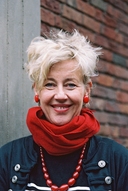
Carola Bauckholt, Director
Composer, publisher and intermedia artist
Member of the Section (since 2013), Director (since 2021)

Carola Bauckholt
© Hermann Wakolbinger
The Music Section was established in the first half of the 19th century; in terms of its membership and programmes, it is representative of contemporary composition, sound art and performance with a focus on present-day and future concerns.
The section can look back on a long tradition that includes a number of famous members, such as Richard Wagner, Arnold Schoenberg, Hanns Eisler and Igor Stravinsky. Over the past 20 years there has been a steady increase in the proportion of women in the membership’s make-up, and the section overall has become more diverse in terms of members’ origins and gender and the genres and musical practices represented.
The Music Section’s programming is developed by members in collective processes, involving close exchange with the independent scene in Berlin and with international project partners carried out on an ongoing basis. The programmes are representative of current themes bearing on contemporary issues relating to aesthetics, culture or technology. The crossover between disciplines is just as important as the exchange between the audience and the musicians.
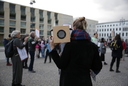
The Music Section is committed to developing its own programme – which takes the form of concerts, exhibitions, symposia, talks, concert series and festivals – and to working together with Berlin’s independent scene to create partnerships focused on selected projects and overarching themes.
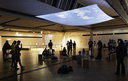
The Akademie der Künste’s spaces on Hanseatenweg and Pariser Platz consistently provide new options for listening to and engaging with sound and music, which may be presented in small or large formats, in intimate settings, indoors or outdoors, performed on the stage or with projections on the building façade. They create the context for ways of approaching the world acoustically, for a varied range of artistic experiences and journeys into the imagination. The Music Section sets great store by its collaboration with members from other sections.
The section also sets out to represent the interests of contemporary composition, advocating for the music scene in the area of cultural policy; it is a committed member of various associations, including initiative neue musik berlin e.V., the Landesmusikrat (representing music associations at state level) and GEMA.
Composer, publisher and intermedia artist
Member of the Section (since 2013), Director (since 2021)
Composer, performer and author
Member of the Section (since 2013), Deputy Director (since 2021)
Former directors are Manos Tsangaris (2012–2021), Erhard Grosskopf (2008–2012), Udo Zimmermann (2003–2008) and Frank Michael Beyer (1986–2003).
Former deputy directors are Samir Odeh-Tamimi (2018–2021), Enno Poppe (2012–2018), Manfred Trojahn (2008–2012), Erhard Grosskopf (2003–2008) and Georg Katzer (1994–2003).
The Music Section has been exploring the topic of diversity in contemporary music for a number of years, looking at gender, genre, ethnicity and cultural practices. This has given rise to three “Curating Diversity” symposia, a collaborative undertaking organised together with field notes / initiative neue musik berlin e.V. and the Ultima Festival; the “Memory of Hearing” concert series; the “Memories in Music” festival, which was dedicated to the cultural memory of music for different sound languages; and the transcontinental project Oscillations: Cape Town – Berlin. This last was developed cooperatively with the Centre for Humanities Research at the University of the Western Cape in Cape Town and Deutschlandfunk Kultur and culminated in a sound exhibition that ran for several weeks in 2024.
One of the section’s major interests is in the complex issues relating to climate, the environment and sustainability, which have informed its programming since 2022. In 2023 the section organised the “Time to Listen” festival, which featured concerts, a symposium, an exhibition of sound art, a community day and workshops. The festival explored the idea of climate justice, while reflecting on sound’s ability to touch and on the (cognitive) power of listening and its capacity for evoking empathy. The “Time to Listen” symposium was planned together with field notes / initiative neue musik berlin e.V.; two-day events are to take place each year until 2026, with musicians and interested parties invited to engage with the topic and work in open formats to develop strategies for achieving a climate-just future.
In addition, members of the public are invited on a regular basis to join experts in the Climate Café (as part of the European Alliance of Academies). A climate salon is held at regular intervals conducted by Iris ter Schiphorst and Kirsten Reese.
In 2018 the section launched the “Winter Music” festival, which takes place every two years in December, curated by different members of the section in alternation and based on works created by other members. This is an opportunity to introduce new members to the public and to dig out old works by long-standing members. The programme is presented by ensembles and musicians from the independent scene.
There have been some outstanding recent productions in connection with exhibitions staged by the Akademie der Künste. The concert series on major undertakings like “Kunst und Revolte ’89” (Art and Revolt ’89, 2009) or the Cage Year “A Year from Monday. 365 Tage Cage” (365 Days of Cage, 2011/12) have been followed by extensive musical and performative programmes in the form of “Music in Vertigo of Reality” (2014), “Music for Everyone” (2015) and “Decentralised Music” (2016).