Structure and Tasks
The structure and tasks of the Akademie der Künste are defined by law. The artistic programmes are conceived, developed and realised by its members.
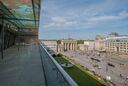
Roof terrace at Pariser Platz
© Andreas [FranzXaver] Süß
Presidency and Senate
The members elect the president and vice-president, as well as the Section directors and their deputy directors, for a term of three years. The directors of the Sections are all members of the Akademie Senate, which, along with the president as chair, meets to consult and decide on all the Akademie der Künste’s plans and projects. The president, vice-president, directors and their deputies hold office in an honorary capacity. The Akademie’s decision-making bodies are the Sections, the Senate and the Plenary Assembly, which meets twice a year during meetings of the General Assembly.
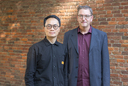
Manos Tsangaris, President of the Akademie der Künste, and Anh-Linh Ngo, Vice-President (f.r.t.l.)
© gezett
Since May 2024, composer, drummer and installation artist Manos Tsangaris has been the president of the Akademie der Künste. Anh-Linh Ngo, architectural publicist, curator and editor-in-chief, is vice-president.
Senate
The directors of the six Art Sections, together with their deputies, form the Senate of the Akademie der Künste.
- Visual Arts
Karin Sander, director
Arnold Dreyblatt, deputy director
- Architecture
HG Merz, director
Regine Keller, deputy director
- Music
Carola Bauckholt, director
Iris ter Schiphorst, deputy director
- Literature
Kerstin Hensel, director
Cécile Wajsbrot, deputy director
- Performing Arts
Nele Hertling, director
Mark Lammert, deputy director
- Film and Media Arts
Helke Misselwitz, director
Peter Badel, deputy director
President's Office
The presidential secretary assists and represents the president in his role as spokesperson for the Akademie vis-à-vis the state and the public and as chair of the General Assembly and the Senate. They head the President’s Office, which also includes the KUNSTWELTEN Education Programme, the European Alliance of Academies, and the Communications Department.
Bettina C. Huber-Evers has been the presidential secretary and a member of the Executive Board since 2018.
Artistic Programmes
The Akademie der Künste’s unique characteristic – and one that distinguishes it from other arts institutions – is the active engagement and support of the artists who are its members. They work closely with the head of Programming to shape the programme content and make it a reality.
The work of the Art Sections is carried out by their secretaries. The Sections develop, coordinate and carry out art projects, exhibitions and events. These include both specific initiatives of the individual art genres and interdisciplinary, Akademie-wide projects, in which several Sections collaborate or work in parallel.
The head of Programming plans and coordinates the Akademie’s programme parameters – in collaboration with the president and vice-president, the Section directors and secretaries as well as the Archives director – and is responsible for the implementation of cross-section projects.
Head of Programming and Secretaries
Johanna M. Keller has been head of Programming and a member of the Executive Board since 2022.
The current secretaries of the Sections are:
- Visual Arts
Dr. Anke Hervol
Dr. Angela Lammert, head of Interdisciplinary Projects
- Architecture
Carolin Schönemann
- Music
Julia Gerlach
- Literature
Dr. Nathalie Mälzer
- Performing Arts
Caroline Rehberg
- Film and Media Arts
Cornelia Klauß
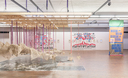
The Great Repair, exhibition view, Akademie der Künste, 2023
© David von Becker
Included in the “Artistic Programmes” are the JUNGE AKADEMIE fellowship programme, the Studio for Electroacoustic Music and the Akademie’s Archives with their important collections and artists’ estates. Exhibitions and events are also planned and carried out by these sectors.
KUNSTWELTEN is the cultural education programme of the Akademie der Künste, which fulfils the institution’s objective of engaging the general public in the arts. The programme, aimed at children, teens and adults, draws on the Akademie’s resources, including the expertise and creative works of its members and fellows, art collections, and extensive interdisciplinary archives.
In this way, active collaborations and outside cooperations create a distinctive arts programme at the intersection of contemporary discourse, historical heritage and legacies, arts education and social commitment.
Learn more
Archives of the Akademie der Künste
Largest Interdisciplinary Collection in Germany
In fulfilment of its statutory task of preserving cultural heritage, the Akademie der Künste conserves in its Archives the largest interdisciplinary collection of leading literary and artistic estates and papers from artists and artists’ organisations in Germany, maintains an art collection and an extensive library, and supervises its archival records, which date back to 1696.
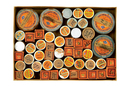
Boxes with rolls of negatives from the Walter Kempowski Archives, Akademie der Künste
© Roman März
The Archives’ main task is to preserve, expand and catalogue its holdings. It presents its valuable collections in exhibitions, publications, and events. The Archives’ holdings are accessible to the interested public.
The genesis and profile of the Archives would be inconceivable without its close ties to the Akademie. Its members provided the first impetus for a teaching and exhibition collection. Their artistic work serves as the focus of archival acquisitions, while the Akademie’s membership structure, encompassing all fields of art, crucially shapes the multidisciplinary collecting concept.
Werner Heegewaldt has been director of the Archives and a member of the Executive Board since 2016.